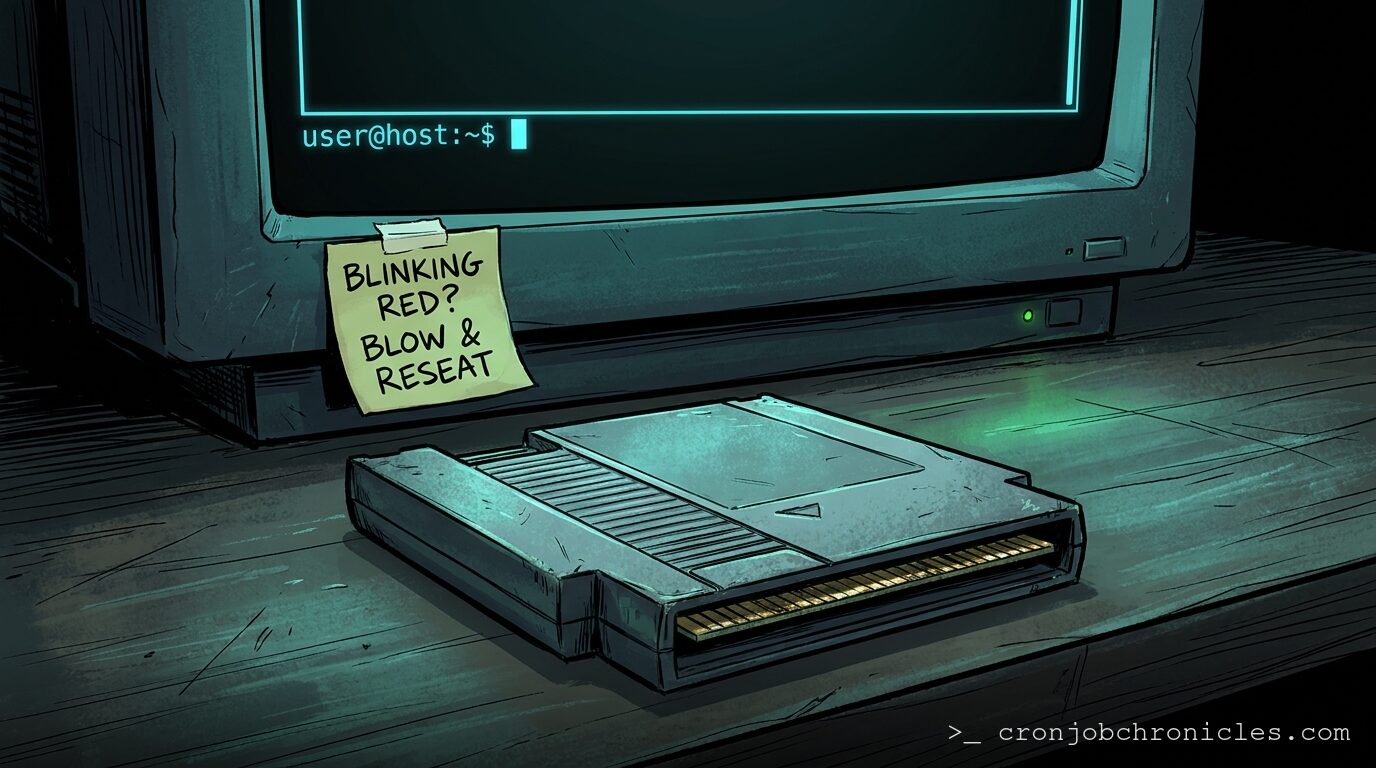
Listen, a Nintendo cartridge never went down because an admission webhook certificate expired in kube-system.
You pushed the plastic down, flipped the power switch, and the CPU read its reset vector straight out of fixed ROM addresses—$FFFC and $FFFD on the NES 6502—and started executing game code before the CRT phosphor finished warming up. No kernel boot, no initrd, no overlay filesystem, no containerd unpacking tarball layers over TLS from a registry three regions away. The software and the hardware shared an address bus and nothing else.
When we talk about uptime today, we usually mean the delicate truce between forty-seven moving parts that all have to agree on the current state of the universe before a single request gets routed. On a modern cluster, serving a static JSON blob can quietly depend on CoreDNS, kube-proxy iptables rules, an ingress controller, a mutating webhook, and three etcd members surviving a momentary storage fsync spike. Cartridge uptime looked effortless because everything that can break in a distributed system had simply been left out of the box.
The original CrashLoopBackOff
The closest thing the 8-bit era had to modern operations was the blinking red power light on a front-loading NES. Kids thought the console was haunted; what was actually happening was a failed health check. Inside the cartridge sat the 10NES lockout chip, wired to trade lockout pulses with a twin chip on the motherboard. When the 72-pin ZIF connector bent out of shape or collected grime, the handshake dropped, and the lockout chip pulled the CPU reset line roughly once every second.
An infinite reboot loop triggered by a flaky pin. You have seen the exact same behaviour in CrashLoopBackOff, except Kubernetes politely stretches the retry interval until it caps out at five minutes while your monitoring dashboard turns orange.
Even the superstition matches. Every kid knew you fixed a blinking NES by pulling the cartridge out and blowing into the slot. In reality, warm breath deposited moisture onto brass edge contacts and accelerated oxidation. What actually cleared the fault was the physical friction of pulling the board out and shoving it back in, scraping a fresh path through the tarnish. Modern ops does the same ritual with kubectl delete pod—never fixing the leaky sidecar or the starved liveness probe, just reseating the workload until the red light stays solid for another afternoon.
The price of baked-in silicon
Of course, comparing a read-only cartridge to a Kubernetes cluster is fundamentally unfair. A cartridge had no users writing to a shared database, no compliance patches, and no Friday afternoon hotfix when a rounding error broke checkout. Its uptime came from radical immutability: once the mask ROM left the factory in Kyoto, nobody was rolling out a canary release.
That rigidity cut both ways. When Donkey Kong 64 couldn’t run reliably in the stock N64’s 4 MB of RAM late in development, Nintendo bundled a physical 4 MB Expansion Pak module into every retail box rather than delay the cartridge. We complain about YAML sprawl, yet none of us want to ship physical silicon every time someone forgets to close a file descriptor.
Orchestrating Tetris
The trouble is not Kubernetes itself; the trouble is paying the cluster tax for workloads that have the operational complexity of Tetris. Half the internal tools running on multi-zone control planes today could live happily as a single compiled binary managed by systemd on two boring virtual machines.
Still, I catch myself reaching for the cluster anyway, spinning up manifests and health endpoints for something that barely gets ten requests a minute. The templates are already sitting in a repository, the CI pipeline knows the incantation, and choosing a simpler setup feels like explaining why you didn’t use the shiny standard tool everyone else expects to see on the diagram.
Then a kubelet stalls, an etcd leader election fires at three in the morning, and you remember how fast a system recovers when there is no control plane to consult. Hold on—the staging ingress just started throwing 502s, and I am already halfway through typing kubectl rollout restart instead of reading the logs.