Listen, if you think Kubernetes is just a “container orchestrator,” you’ve already failed the interview before you’ve even walked through the glass doors.
I was asked the other day to explain Kubernetes to an eight-year-old. It felt like being asked to explain the heat death of the universe while showing a toddler how to use a plastic fork. We tend to frame Kubernetes as this grand, orderly abstraction—the “operating system of the cloud.” But maybe that’s just a bedtime story we tell ourselves to avoid admitting that we’ve built a self-healing monster that, on its best days, behaves like a distributed system having a fever dream.
When you explain Kubernetes to a child, you don’t talk about CNI plugins or the intricacies of the etcd consensus algorithm. You talk about chores. You talk about the messy, chaotic reality of wanting a clean room, but having a dozen toys that keep teleporting into the wrong bins.
The Toy Bin Infrastructure
Imagine your room is a data center. You have a bunch of toys—Lego sets, action figures, plushies. In the old days, you’d just throw them in a pile. That’s your monolith. It works until you can’t find the specific gear for your Batman figure because it’s buried under a mountain of dirty socks.
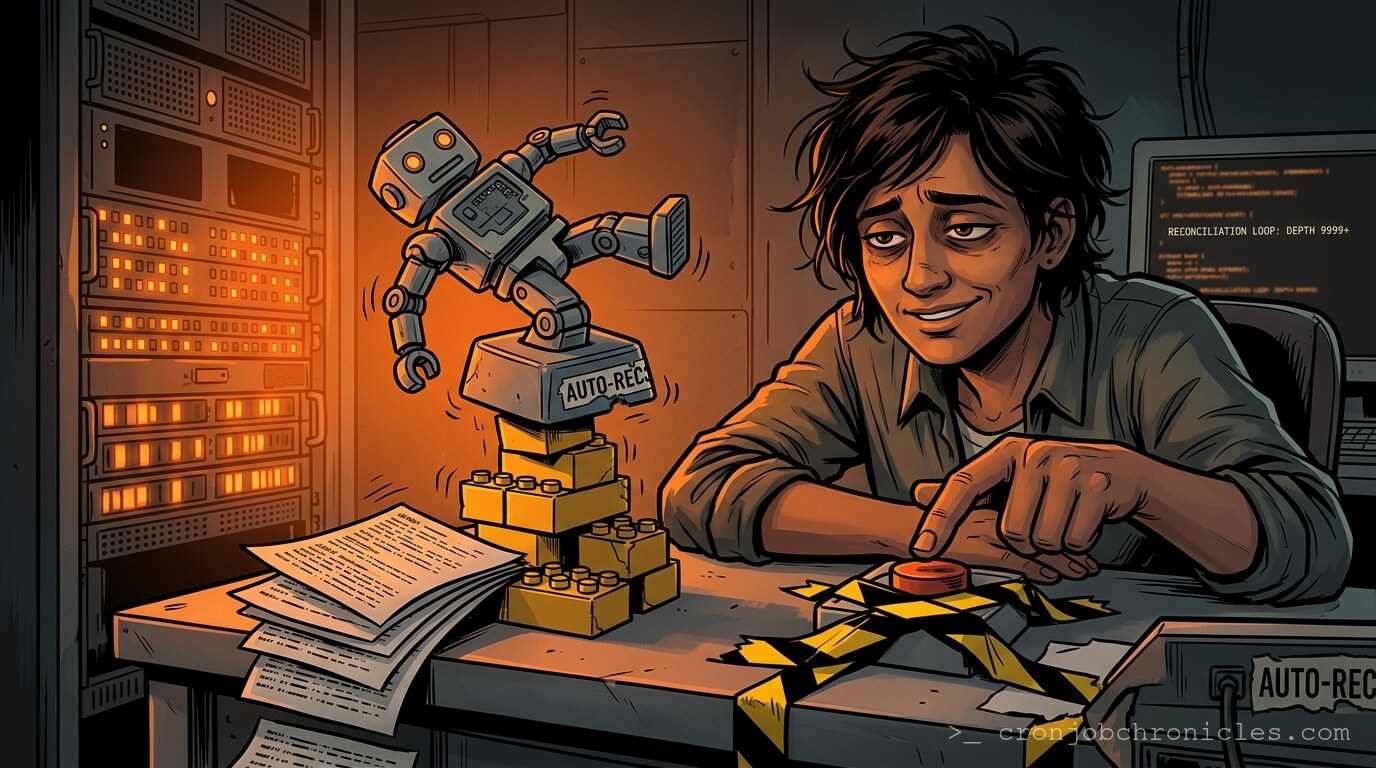
Kubernetes is like hiring a team of invisible, hyper-caffeinated butlers. We call these the “Controllers.” You tell them, “I want three action figures on the shelf at all times.” If you knock one over—or if one decides to spontaneously combust, as processes are wont to do—the butler immediately runs over, cleans up the mess, and puts a new one back in its place. That’s “Desired State” configuration. You don’t manage the toys; you manage the rule that says the toys must exist.
But here’s the rub: what if the butler is the one who knocks the toy over? What if the “self-healing” loop enters a crash-loop backoff because the shelf is broken? We pretend this is elegant, but it’s often just a recursive nightmare of configuration drift. Is the system actually “intelligent,” or have we just automated our own panic?
The Realities of the Sandbox
Before you start deploying your “toys,” you need a cluster. You can’t just have a room with no shelves. You need:
- Control Plane: The parent standing in the doorway, watching everyone, ensuring the rules aren’t being violated.
- Worker Nodes: The shelves themselves—the compute, the memory, the actual space where the heavy lifting happens.
- Kubelet: The little agent that talks to the parent, admitting when a shelf is full or when a toy has gone missing.
It’s all fun and games until you realize you’re managing dependencies. You want your Batman figure to have his Batmobile, but the Batmobile is in a different room, and there’s a network latency issue because your brother is hogging the hallway bandwidth. That’s the “Service” layer—the glue that makes disparate, ephemeral components feel like they’re actually talking to each other.
A Practical Application: The “Snack Controller”
Since we’re talking about managing state, let’s look at something truly mission-critical. Managing your snack inventory is no different from managing a fleet of microservices. If you don’t declare your desired state, you end up with a famine.
#!/bin/bash
# snack_controller.sh - Ensuring desired state of the pantry

set -e

declare -a DESIRED_SNACKS=("Goldfish" "FruitGummies" "StringCheese")
LOG_FILE="/var/log/snack_ops.log"

log() {
    echo "[$(date +'%Y-%m-%dT%H:%M:%S%z')] $1" >> "$LOG_FILE"
}

check_pantry() {
    log "Reconciling current pantry state with desired state..."
    for snack in "${DESIRED_SNACKS[@]}"; do
        if [ ! -f "/pantry/$snack" ]; then
            log "ALERT: $snack missing. Triggering deployment."
            touch "/pantry/$snack"
            log "SUCCESS: $snack has been deployed."
        fi
    done
}

# Infinite loop of reconciliation, much like K8s controller-manager
while true; do
    check_pantry
    sleep 5
done
The Question We Aren’t Asking
Is this actually helping? We spend our entire careers building these complex, multi-layered “orchestration” systems to keep our services running in a perfect, immutable state. But maybe the constant churn of containers and the frantic, automated restarts are just a way to ignore the fact that the code itself might be the problem. Maybe we aren’t managing systems; we’re just managing our own inability to write stable software. It’s a profound thought, or maybe it’s just the burnout talking.
We build these “resilient” architectures to survive everything—network partitions, node failures, regional outages—yet we’re all terrified of a simple `kubectl delete` command. It’s a strange irony, isn’t it? We create a god-like entity to watch our toys, then spend our nights trembling, hoping it doesn’t decide to delete the entire production namespace because of a missing semicolon in a YAML file.
Actually, hold on. My pager just lit up. The load balancer is flapping, the API gateway is throwing 503s, and if I don’t go check the metrics, this entire “self-healing” infrastructure is going to turn into a very expensive paperweight. It doesn’t matter how much I explain this to an eight-year-old; the pager doesn’t care about my metaphors.