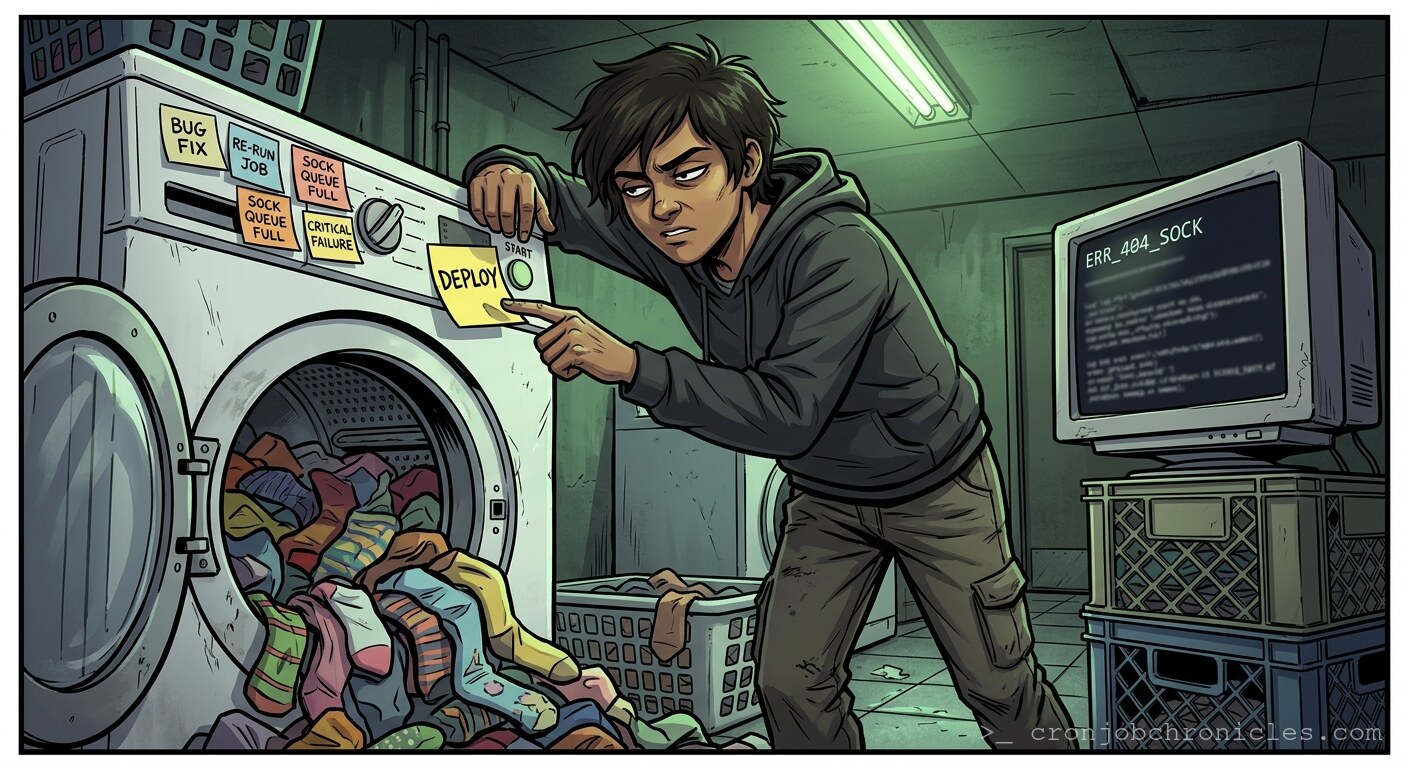
Listen, if you think your home laundry routine isn’t just a high-latency CI/CD pipeline running on wetware, you’ve clearly never had to troubleshoot a production deployment of clean socks at 7 AM.
We often talk about “systems” in the data center as if they are sacred, immutable architectures. But look at the average laundry cycle. It is, by definition, a continuous integration and deployment process prone to the same entropy that haunts our server racks. You are taking dirty, untracked source code (the hamper), running it through a series of build stages (wash, dry, fold), and deploying it to the production environment (your wardrobe).
The problem isn’t that the pipeline fails. The problem is that we treat it like a human-operated task instead of a state-managed orchestration. We are the legacy middleware, and frankly, we’re the bottleneck.
The Architecture of a Detergent-Based Pipeline
Every load of laundry is a discrete microservice. You have your inputs: a heterogeneous mix of fiber-types and color profiles. You have your environment configuration: the wash cycle (the runner), the temperature (the environment variable), and the detergent (the dependencies). If you set the temperature too high for delicate fabrics, you’ve introduced a breaking change to the production environment that results in catastrophic data loss—or, as the laypeople call it, a shrunken sweater.
Why do we treat laundry as a manual process? Is it because we think it’s “simple”? That’s the classic hubris of the sysadmin. We assume that because we understand the mechanics, we control the outcome. But the moment you start mixing whites and darks, you are violating schema migration best practices. You are inviting cross-contamination, a scenario analogous to having your development database credentials accidentally hardcoded into your production config. The crash is inevitable; the cleanup is humiliating.
Prerequisites for a Production-Grade Laundry Cycle
- Version Control: Sort by color and fabric weight (Schema Validation).
- Environment Variables: Correct detergent volume for the load size (Resource Allocation).
- Runtime: Ensuring the drum isn’t overloaded (CPU/Memory overhead).
- Deployment Target: A clean, dry folding surface (The target environment).
There is a lingering doubt, however, that haunts every senior engineer: does the machine actually make anything “cleaner,” or does it simply redistribute the grime? We tell ourselves it’s a process of state transition, from “dirty” to “clean,” but perhaps we’re just running an endless loop of cleanup scripts that never quite purge the system logs. We’re moving the mess from one directory to another, hoping the checksums match.
Automating Your Domestic State Management
If you insist on continuing this manual charade, at least automate the notification process. Below is a simple Bash script that acts as an orchestration manager for your laundry cycle. It ensures that your resources aren’t left in a “damp-stale” state, which is essentially the physical world equivalent of a zombie process eating up your system resources.
#!/bin/bash
# Laundry Service Orchestrator v1.0
# Usage: ./laundry_check.sh [cycle_duration_minutes]

set -euo pipefail

LOG_FILE="/var/log/laundry_svc.log"
DURATION=${1:-45}

log_event() {
    echo "$(date '+%Y-%m-%d %H:%M:%S') - [INFO] - $1" >> "$LOG_FILE"
}

if [[ $# -eq 0 ]]; then
    log_event "No duration set. Defaulting to 45 minutes."
fi

log_event "Starting wash cycle deployment..."
sleep $((DURATION * 60))

# Post-deployment validation
log_event "Deployment complete. Running checksum on garment dryness..."
echo "ALARM: Laundry service has reached 'End of Life'. Please trigger manual folding deployment." | wall
The Frame Break: Are We Just Chores in a Void?
I find myself questioning why we obsess over the “optimization” of these tasks. Is the goal of a life well-lived the successful, bug-free execution of a series of domestic microservices? Or is there a fundamental fallacy in trying to engineer our way out of the chaos of entropy? Perhaps the laundry isn’t a pipeline to be mastered, but a recurring system error we’re too proud to admit we can’t patch.
We build these mental frameworks to exert control over a world that is fundamentally indifferent to our desire for order. We pretend that if we follow the manual—if we separate the lights from the darks, if we use the correct spin speed—the universe will remain stable. But eventually, a sock goes missing. It vanishes into the ether of the machine’s architecture, a dangling pointer in the middle of a perfectly executed script. No amount of debugging can recover that sock. You just learn to live with the lost state and deploy the remaining assets.
It’s late, and the documentation for this existence is laughably thin. I’ve just been pinged by an automated monitoring tool indicating that my storage array is throwing I/O errors, which is a much more pressing, and significantly more annoying, form of chaos than the basket of unfolded clothes sitting behind me. Now, if you’ll excuse me, I have a controller that’s hanging in a loop, and it doesn’t care about your fabric softener settings.