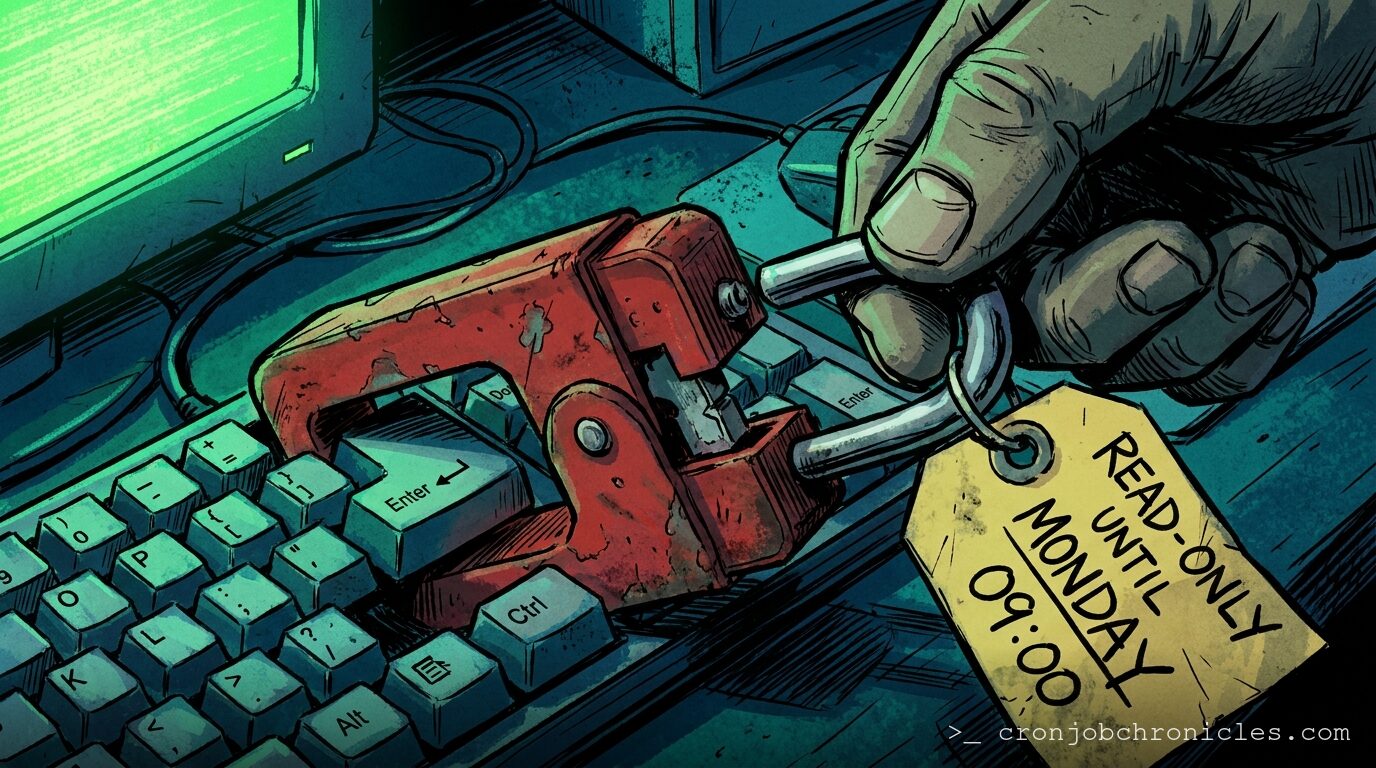
Listen, the people who tell you “if you can’t deploy on Friday, your pipeline is broken” are usually the ones who don’t carry the pager.
It is a beautiful, seductive theory. You have 100% test coverage. Your green build passes. Your canary deployments slowly bleed traffic over to the new containers, and your automated rollbacks are configured to trigger the moment latency spikes. In this clean, simulated world of slide decks and keynote presentations, Friday is just another day. In the real world, systems are haunted by silent failures, and human attention is a finite resource with a sharp drop-off at 5:00 PM.
The Latency of Failure
The core fallacy of the continuous-deployment-anytime movement is the assumption that failure is immediate. If a deployment is bad, the theory goes, the health checks fail, the deployment rolls back, and no one gets hurt. But the most painful failures do not trigger HTTP 500 spikes within three minutes of a rollout.
Consider the classic slow-burn disaster: a legacy application that doesn’t handle log rotation gracefully. You push a minor change to the logging library on Friday afternoon. The deployment succeeds. The canary is happy. You close your laptop and head out.
At midnight, the daily logrotate cron job runs. It rotates the log file, but because the application process doesn’t support SIGHUP and the configuration lacks the copytruncate directive, the application continues writing to the deleted file descriptor. To the monitoring system, everything looks normal. Memory is fine, CPU is low. But the disk space isn’t being freed because the deleted file is still open. At 4:00 AM on Saturday, the partition hits 100% capacity. The database engine, unable to write to its write-ahead log, panics and shuts down. You can diagnose this with a quick lsof +L1, but first, you have to wake up, find your glasses, and figure out why the entire cluster is offline.
This is not a failure of your CI pipeline. Your pipeline cannot predict how a system daemon configured three years ago will react to a file descriptor change under a specific cron schedule. It is a failure of system latency.
The Human Context-Switch
When a system fails at 2:00 PM on a Tuesday, the recovery time is measured in minutes. The team is online, their heads are in the codebase, and the context of the recent change is fresh in everyone’s mind. The engineer who wrote the code is likely sitting in the same Slack channel, if not the same room.
At 2:00 AM on a Saturday, the recovery time is measured in hours. The context is gone. The engineer who pushed the change is asleep. The on-call engineer who gets paged has to climb out of deep sleep, establish VPN access, find where the documentation is kept, and reconstruct the mental model of a system they might not have touched in months.
Even worse, we are less rational when we are tired. The temptation to apply a quick, dirty fix to get back to sleep—like running a hard reboot on a database node instead of investigating why the replication lag is growing—often turns a minor incident into a multi-day data recovery effort.
The Self-Inflicted Wound
I would love to say I only watch others make these mistakes. But I still remember the Friday I decided to “quickly” clean up some unused systemd timers before leaving for the weekend. One of them was an old backup verification script that had been disabled for months. I stopped the timer, disabled it, and ran systemctl daemon-reload.
What I didn’t realize was that the service unit associated with that timer had a syntax error in its configuration which, upon the next system reload, caused a critical system logging daemon to fail silently on its next restart. The machine didn’t reboot until Sunday night during an automated kernel update, leaving us with zero logs for a critical twelve-hour window when a routing issue occurred.
The urge to “just get this one last thing done” before the weekend is a psychological trap. It is driven by the desire for a clean slate on Monday, but it ignores the reality that our cognitive load is highest at the end of the week. We are tired, our attention to detail is degraded, and we are far more likely to miss the subtle warning signs in a dry-run output.
What Fridays Are Actually For
A strict Read-Only Friday policy does not mean we sit on our hands. It means we shift our focus from changing the state of the infrastructure to understanding it.
Friday is the day for low-risk, high-value work that doesn’t involve pushing code to production. It is the day you read the logs you ignored all week. It is the day you run findmnt --verify to make sure your fstab file won’t break on the next reboot. It is the day you update your documentation, prune stale dashboard alerts that everyone has learned to ignore, and verify that your offsite backups are actually readable.
If your team feels like they are losing velocity by keeping Fridays quiet, you are measuring the wrong things. The velocity gained by deploying a feature three days early is completely wiped out by the three days of post-incident review, database restoration, and customer apology emails that follow a weekend outage.
My terminal chimes. A direct message from the junior engineer: “Hey, I noticed a tiny typo in the production proxy configuration. Mind if I push a quick fix before I log off?”