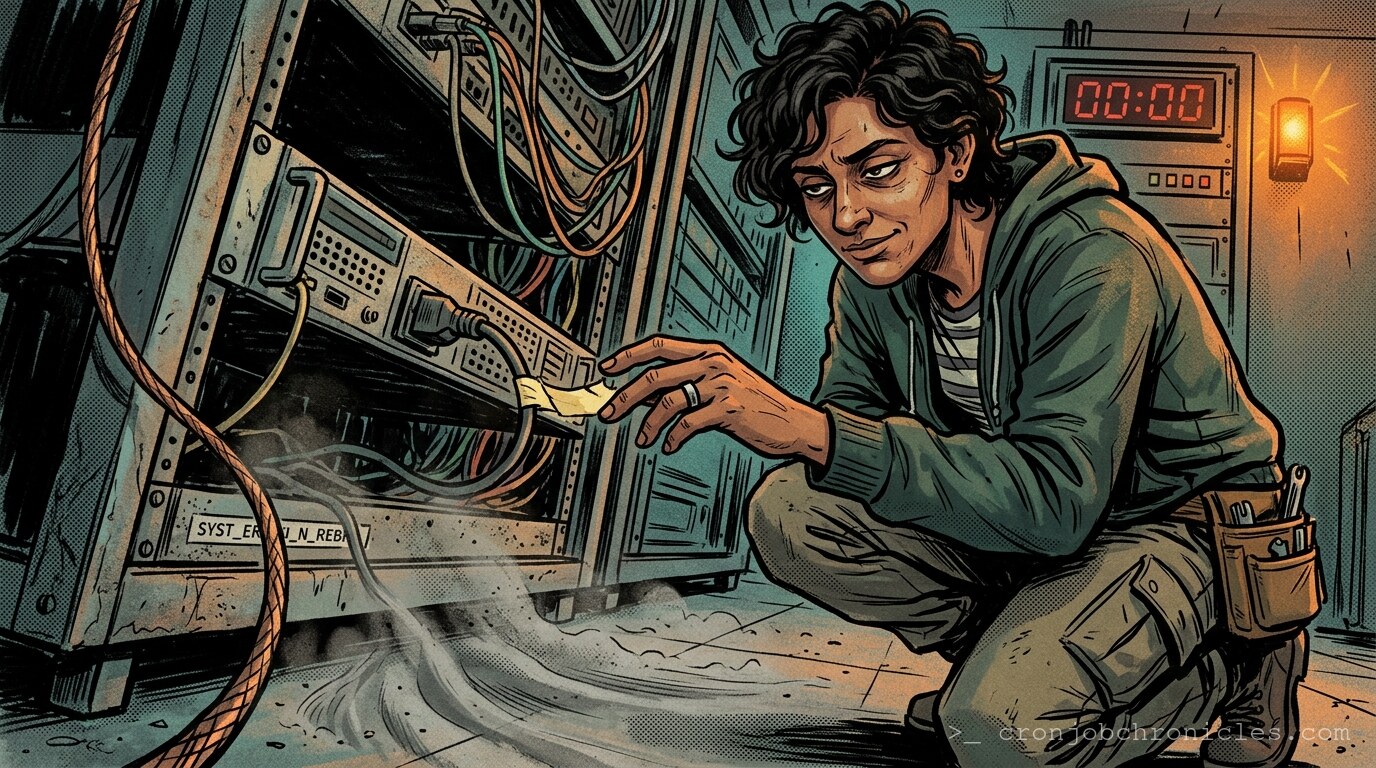
Listen, if you haven’t spent at least one night of your career praying to a deity you don’t believe in because a server from the Bush administration is making a sound like a woodchipper filled with loose change, you aren’t a system administrator; you’re a tourist.
We all have one. That rack in the corner, usually buried under a pile of tangled Cat5 cables that look like a bird’s nest designed by M.C. Escher, housing the “No-Touch Zone.” It’s a legacy piece of hardware—maybe a Sun Fire V240 or a battered Dell PowerEdge R710 that somehow still boots—and the only reason it’s still running is because the universe is afraid of what will happen if you reboot it. We call this stability; we should probably call it hostage negotiation.
There is a peculiar tension in the No-Touch Zone. We convince ourselves that we are maintaining uptime. But are we? Or are we just curating a museum of technical debt, acting as the night guards for a ghost that stopped being useful around 2012? There is an inherent absurdity in the fact that I can provision an entire software-defined data center in the cloud with a few lines of Terraform, yet I spend 40% of my intellectual bandwidth making sure a specific RAID controller from the early 2000s doesn’t lose its mind.
The Anatomy of “Hopes and Dreams” Architecture
The No-Touch Zone survives on three pillars: fragile configuration, binary bloat, and the absolute refusal of the business to pay for a migration. The hardware is often physically degrading. I’ve seen electrolytic capacitors that look like they’re pregnant, holding on by the grace of a steady room temperature and low humidity.
When you approach one of these beasts, you don’t perform maintenance; you perform an exorcism. You don’t touch the power cable. You don’t even look at the blinky lights for too long, lest you give the sensors a reason to report a fault. We tell ourselves that it’s “hardened” by time, but in reality, it’s just brittle. If you nudge the chassis, the backplane might decide that today is the day it finally retires to a farm upstate.
The Ritual of Maintenance: A Technical Perspective
Since we cannot touch the hardware, we settle for “observability without interaction.” We monitor these systems like we’re stalking a wild animal. We use low-impact scripts to poll for vitals, but even that feels like tempting fate. Here is a script I wrote—half-ironically, half-desperately—to keep a log of whether the “No-Touch” box is still breathing. It doesn’t use SNMP or IPMI, because god forbid we wake the sleeping beast with a standard query. It just checks the heartbeat via a polite ping, then logs it with the gravitas of a funeral dirge.
#!/bin/bash

# The "No-Touch Zone" Watcher
# Because if you ping it too hard, it might just give up.

LOG_FILE="/var/log/no_touch_zone.log"
TARGET="10.0.0.66" # The artifact

log_message() {
    echo "$(date '+%Y-%m-%d %H:%M:%S') - [STILL BREATHING]: $1" >> "$LOG_FILE"
}

# Check for existence of the log file, handle gracefully
touch "$LOG_FILE" || { echo "Cannot touch log file. Even the filesystem is scared."; exit 1; }

# The delicate ping. We don't flood it. We offer a gentle knock.
if ping -c 1 -W 2 $TARGET > /dev/null; then
    log_message "The beast responds. Carry on, nothing to see here."
else
    # The moment of dread.
    echo "$(date '+%Y-%m-%d %H:%M:%S') - [PANIC]: The artifact is silent." >> "$LOG_FILE"
    # Do not call anyone. Just weep.
    exit 1
fi
Restoration: The Hypothetical That Haunts Us
I am often asked for a “restoration procedure” for these legacy monsters. There is no restoration. There is only a scorched-earth policy. If the No-Touch Zone fails, you aren’t restoring; you’re engaging in high-stakes archeology. You’re looking for a bootable ISO of a kernel that hasn’t been patched since the Obama administration. You’re hoping the tape drive in the basement—which hasn’t been cleaned in a decade—can actually read the LTO-3 cartridges. The “restore” is just an elaborate way of admitting the service is dead. It might be that the fear of restoration is the only thing keeping the hardware alive; we refuse to let it die because we have no plan for a world where it doesn’t exist.
Are we really maintaining systems, or are we just maintaining the illusion of continuity for stakeholders who don’t understand that their business processes are tethered to a literal ticking time bomb of hardware failure? It feels professional, but sometimes it feels like being a Victorian doctor, applying leeches to a server rack.
The Edge of the Abyss
What happens when the No-Touch Zone inevitably gives up the ghost? We blame the hardware. We blame the “legacy infrastructure.” But really, it’s an indictment of our own cowardice. We didn’t migrate it because we were busy, because it was “too hard,” because we were afraid of the unknown. We built a shrine to our own indecision, and we’re forced to bow before it every time the metrics dip.
Maybe the No-Touch Zone is actually the most honest part of the data center. It reminds us that no matter how much we automate, how much we abstract, and how much we pretend to be masters of the machine, we are all just one power surge and one failing power supply unit away from total oblivion. It’s a humbling reminder that our digital lives are built on top of very physical, very fragile piles of silicon that hate us.
Now, if you’ll excuse me, I have a pager alert indicating that the “No-Touch” box is currently sending thermal warnings via a legacy serial console, and it refuses to be reasoned with over SSH. It’s calling to me, and it doesn’t care about your project timelines.