Author: senior_admin

  • The Printers Revenge: Why we still have not solved Paper Jams in 2026

    The Printers Revenge: Why we still have not solved Paper Jams in 2026

    Listen, the paperless office was a lie invented by people who had never met an accountant.

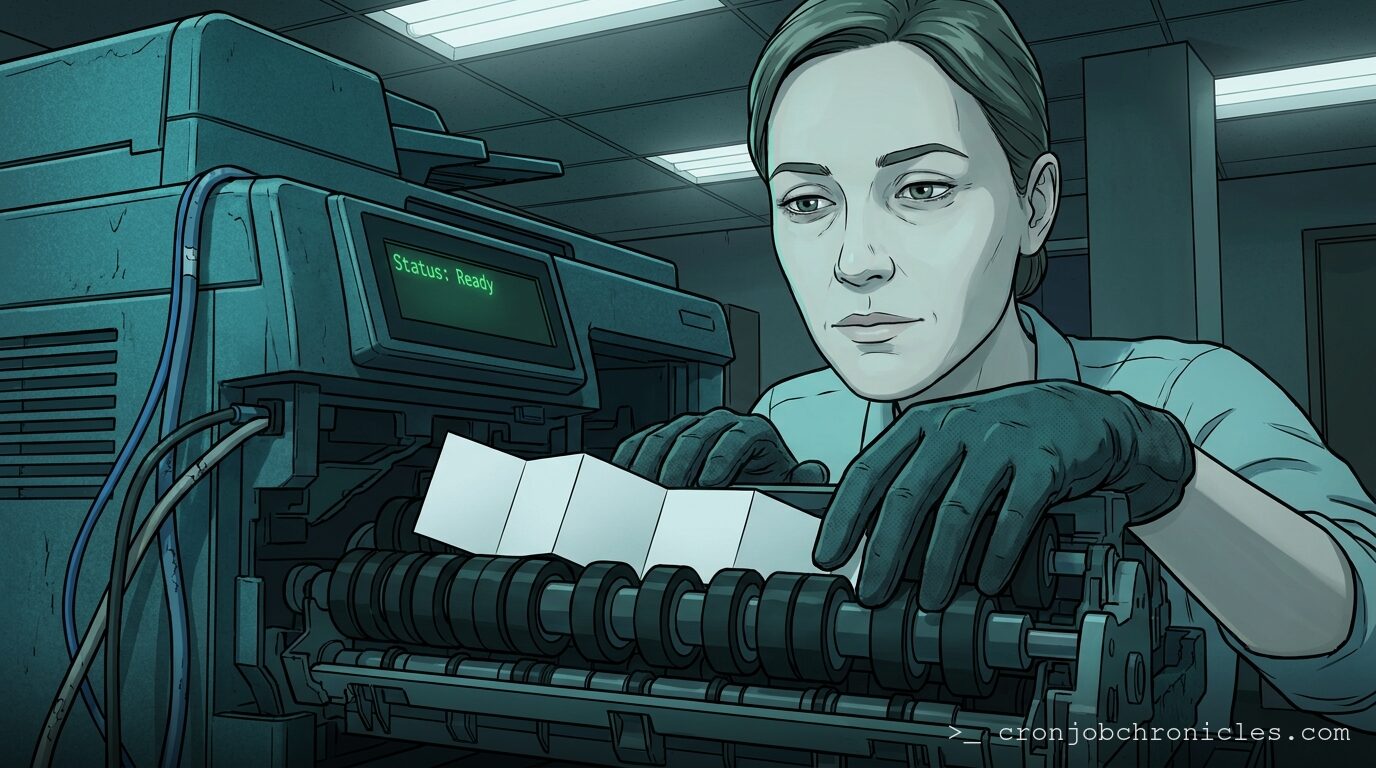
    It is 2026. We are orchestrating multi-region Kubernetes clusters with natural language prompts, deploying databases that replicate across oceans in milliseconds, and running language models on handheld hardware. Yet, three floors down, a highly paid database administrator is currently wrestling with a multi-function laser printer because a single sheet of cheap 70gsm paper decided to curl three degrees too far to the left inside the duplex unit.

    The tech industry spent thirty years trying to abstract away the physical world. We turned servers into files, files into API calls, and API calls into serverless functions. But the printer remains a stubborn, heavy monument to mechanical reality. It is the one place where our clean, stateless digital logic must physically grab a piece of processed wood pulp and drag it across a 200°C fuser roller at twenty inches per second.

    And that is why we still have paper jams.

    The Illusion of “Driverless” Printing

    We thought we solved the software side of this with IPP Everywhere and the deprecation of the classic PostScript Printer Description (PPD) files. The industry promised that driverless printing would save us from the hell of vendor-specific spooler crashes. Today, your phone, your laptop, and your Linux workstation all speak the same Internet Printing Protocol.

    But driverless printing did not solve the translation problem; it merely relocated it. Instead of your workstation processing a complex document into raw page description language, we now stream massive, poorly optimized PDF/raster payloads directly to a printer powered by a low-cost ARM chip and 256MB of RAM.

    When you query the device status, CUPS tells you everything is fine:

    lpstat -p office-laser -l

    The terminal reports printer office-laser is idle. enabled since Tue Jan 13. But the physical machine is currently frozen. Its tiny, underpowered onboard raster image processor (RIP) has run out of memory trying to render an uncompressed transparent layer on page three of a marketing deck. It cannot spool, it cannot clear its buffer, and it certainly cannot actuate the solenoids that control the paper feed timing. The software thinks the job is delivered; the hardware is silently suffocating.

    The Physics of the Feed Path

    No amount of software engineering can overcome the physical degradation of rubber. Inside every printer are pickup rollers made of chlorinated sulfonated polyethylene. Over time, these rollers absorb ozone from the fuser, paper dust from the media, and oil from human fingers. They glaze over, losing the precise friction coefficient required to pull exactly one sheet of paper from the tray.

    When the roller slips, the paper arrives at the registration sensor three milliseconds late. To a modern high-speed printer, three milliseconds is an eternity. The system assumes a feed failure, immediately halts the drive motor to prevent a wrap-around clog, and throws a generic “Paper Jam in Tray 2” error.

    To my shame, I still trigger this myself. Last week, I bought a ream of cheap, unbranded paper because the local supply run was late. I knew the basement storage area was sitting at 65% humidity. I knew the paper would absorb moisture, swell, and cling to its neighbor via static charge. I loaded it anyway. The pickup rollers grabbed two sheets instead of one, the paper path sensors detected a double-feed, and the machine ground to a halt. I knew the physics, but I chose the budget line anyway.

    The Sensor Blind Spot

    Printers are packed with optical interrupters—tiny plastic flags that block an infrared beam when paper passes through them. These sensors are binary. They know if paper is present or absent, but they do not know why.

    If a tiny shred of paper from a previous, violent clearing job remains lodged in the duplex path, the flag stays down. The printer refuses to boot, insisting there is a jam, even though the paper path is visually clear. You are left scanning internal gears with a flashlight, looking for a piece of white cardstock the size of a fingernail.

    The Legacy Legacy

    We are stuck in this loop because printing is an afterthought in the modern stack. Nobody writes fresh code for page rendering anymore; we wrap legacy Unix filters in new containers and hope for the best. When a print job fails, we do not debug the rasterizer. We power-cycle the machine, clearing the physical queue, and try printing the document again as an image.

    We will never solve the paper jam because we cannot patch physical tolerances with a software update. As long as we require physical sheets of paper to pass through hot, moving rollers, we are at the mercy of relative humidity, rubber degradation, and the cheap adhesive on shipping labels.

    A low, mechanical groan begins to vibrate through the floorboards from the hallway. The office multi-function printer is spinning up its main motor, its cooling fan whistling a high-pitched, ozone-scented warning that someone has just sent a 100-page duplex PDF to Tray 2.

  • Frameworks are born. Frameworks die. grep just watches.

    Frameworks are born. Frameworks die. grep just watches.

    Listen, the software industry spends billions of dollars trying to build systems that are smarter than a line-by-line text scan, and every five years we crawl back to the terminal to run the exact same binary we used in 1989.

    The Ephemeral Theater of Search

    We have seen the cycle three times over. First it was localized XML parsers. Then it was enterprise search appliances that cost more than a Honda Civic. Then came the Elasticsearch era, followed by OpenTelemetry and Kibana dashboards that look like the bridge of the Starship Enterprise but take forty seconds to render a bar chart of HTTP 500 errors.

    These tools are born out of a desire to escape the flat file. They want structure, schema, indexes, and cold-storage tiers. But structure requires maintenance. Schemas break when a developer decides a timestamp should include microseconds. Indexes corrupt when the root partition hits 100% capacity because someone forgot to rotate the debug logs.

    When the site goes down at 3:00 AM, nobody opens the observability platform to write a structured JSON query. They SSH into the edge node, bypass the broken log forwarder, and run a utility that hasn’t changed its core interface since Ken Thompson wrote it on a PDP-11.

    The Mechanical Sympathy of the Flat File

    Why does grep win? It isn’t because we are stubborn. It’s because grep understands the hardware better than the frameworks that sit on top of it.

    GNU grep does not read your file line by line using standard library input buffers. It avoids copying bytes altogether. It reads massive blocks into memory using raw system calls, searching for the needle using the Boyer-Moore algorithm, and only looking for newlines when it actually finds a match. It is so fast that, on modern NVMe drives, your search speed is limited by the kernel’s page cache, not the CPU.

    But simplicity has its edge cases, and I still get tripped up by them. Just last week, I spent ten minutes wondering why a standard search on a log directory returned absolutely nothing, only to realize a crashing Go daemon had written a single null byte to the file. GNU grep quietly decided the entire 4GB file was binary and printed nothing but “Binary file matches” to standard output. I had to pass the text flag to get the trace:

    grep -a -C 3 "connection reset" /var/log/nginx/error.log

    I have been doing this long enough to know that flag by heart, yet the muscle memory still failed me, and I stared at an empty terminal like a novice for too long.

    The Text is the Truth

    The modern observability stack wants us to believe that text files are a legacy format. They want structured JSON logs, tracing headers, and span IDs. They tell us that raw text doesn’t scale.

    What they forget is that text is the universal interface of Unix. A JSON log is great until the parser encounters an unescaped double quote and drops the entire line. A database-backed log index is fantastic until the database itself is the thing that crashed.

    When the system is degraded, the tool you use to diagnose the failure must not share dependencies with the failure itself. grep has no dependencies. It doesn’t need a JVM. It doesn’t need a Redis queue. It doesn’t need to resolve DNS. It takes raw bytes from standard input or a file descriptor, applies a regular expression, and dumps the result to standard output.

    The frameworks will keep changing. We will rename log aggregation to observability, and we will rename search indices to vector databases. But under the hood, the bytes still hit the disk, and grep will still be waiting.

    My terminal multiplexer flashes red in the corner. The load balancer is dropping connections, and the Grafana dashboard is currently spinning on a loading icon. I close the browser tab and type grep.

  • The Art of the ‘Read-Only Friday’: Why we don’t deploy before the Weekend

    The Art of the ‘Read-Only Friday’: Why we don’t deploy before the Weekend

    Listen, the people who tell you “if you can’t deploy on Friday, your pipeline is broken” are usually the ones who don’t carry the pager.

    It is a beautiful, seductive theory. You have 100% test coverage. Your green build passes. Your canary deployments slowly bleed traffic over to the new containers, and your automated rollbacks are configured to trigger the moment latency spikes. In this clean, simulated world of slide decks and keynote presentations, Friday is just another day. In the real world, systems are haunted by silent failures, and human attention is a finite resource with a sharp drop-off at 5:00 PM.

    The Latency of Failure

    The core fallacy of the continuous-deployment-anytime movement is the assumption that failure is immediate. If a deployment is bad, the theory goes, the health checks fail, the deployment rolls back, and no one gets hurt. But the most painful failures do not trigger HTTP 500 spikes within three minutes of a rollout.

    Consider the classic slow-burn disaster: a legacy application that doesn’t handle log rotation gracefully. You push a minor change to the logging library on Friday afternoon. The deployment succeeds. The canary is happy. You close your laptop and head out.

    At midnight, the daily logrotate cron job runs. It rotates the log file, but because the application process doesn’t support SIGHUP and the configuration lacks the copytruncate directive, the application continues writing to the deleted file descriptor. To the monitoring system, everything looks normal. Memory is fine, CPU is low. But the disk space isn’t being freed because the deleted file is still open. At 4:00 AM on Saturday, the partition hits 100% capacity. The database engine, unable to write to its write-ahead log, panics and shuts down. You can diagnose this with a quick lsof +L1, but first, you have to wake up, find your glasses, and figure out why the entire cluster is offline.

    This is not a failure of your CI pipeline. Your pipeline cannot predict how a system daemon configured three years ago will react to a file descriptor change under a specific cron schedule. It is a failure of system latency.

    The Human Context-Switch

    When a system fails at 2:00 PM on a Tuesday, the recovery time is measured in minutes. The team is online, their heads are in the codebase, and the context of the recent change is fresh in everyone’s mind. The engineer who wrote the code is likely sitting in the same Slack channel, if not the same room.

    At 2:00 AM on a Saturday, the recovery time is measured in hours. The context is gone. The engineer who pushed the change is asleep. The on-call engineer who gets paged has to climb out of deep sleep, establish VPN access, find where the documentation is kept, and reconstruct the mental model of a system they might not have touched in months.

    Even worse, we are less rational when we are tired. The temptation to apply a quick, dirty fix to get back to sleep—like running a hard reboot on a database node instead of investigating why the replication lag is growing—often turns a minor incident into a multi-day data recovery effort.

    The Self-Inflicted Wound

    I would love to say I only watch others make these mistakes. But I still remember the Friday I decided to “quickly” clean up some unused systemd timers before leaving for the weekend. One of them was an old backup verification script that had been disabled for months. I stopped the timer, disabled it, and ran systemctl daemon-reload.

    What I didn’t realize was that the service unit associated with that timer had a syntax error in its configuration which, upon the next system reload, caused a critical system logging daemon to fail silently on its next restart. The machine didn’t reboot until Sunday night during an automated kernel update, leaving us with zero logs for a critical twelve-hour window when a routing issue occurred.

    The urge to “just get this one last thing done” before the weekend is a psychological trap. It is driven by the desire for a clean slate on Monday, but it ignores the reality that our cognitive load is highest at the end of the week. We are tired, our attention to detail is degraded, and we are far more likely to miss the subtle warning signs in a dry-run output.

    What Fridays Are Actually For

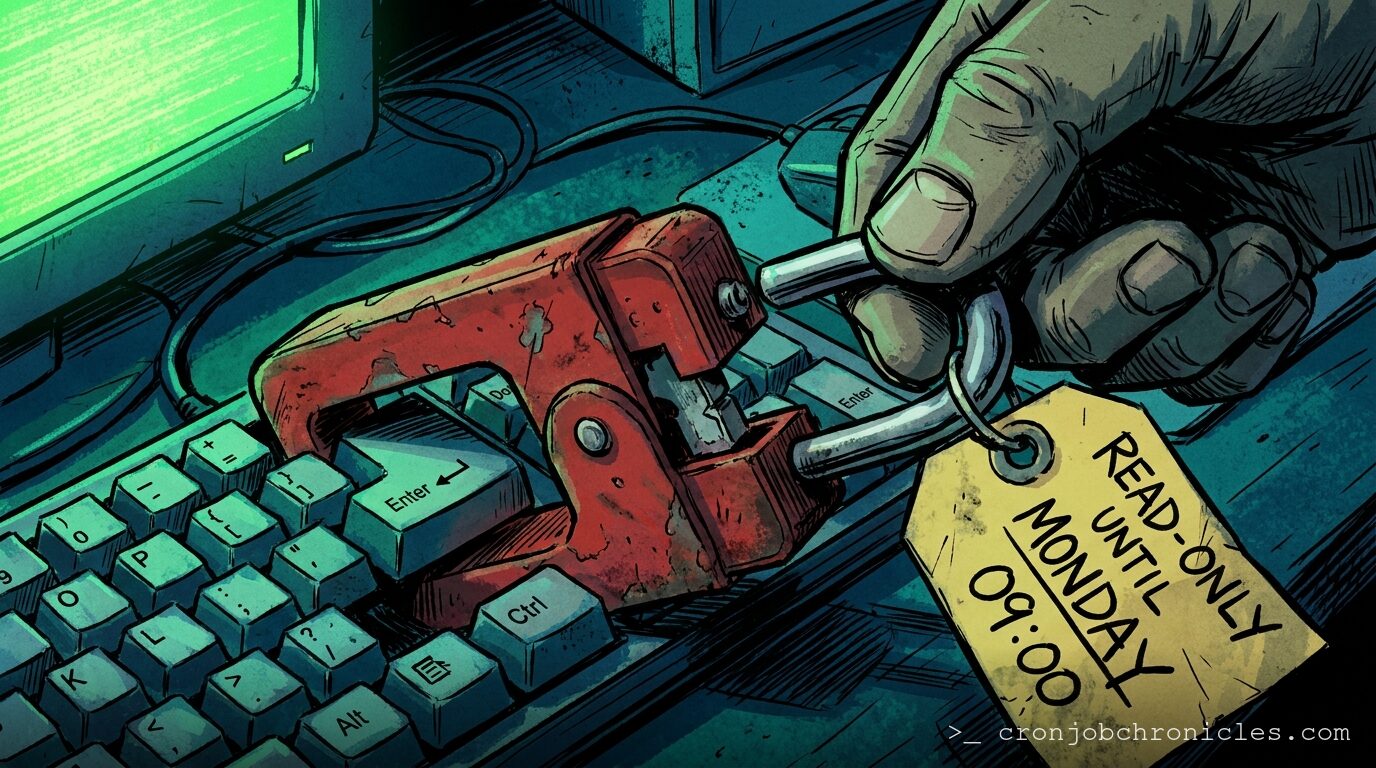
    A strict Read-Only Friday policy does not mean we sit on our hands. It means we shift our focus from changing the state of the infrastructure to understanding it.

    Friday is the day for low-risk, high-value work that doesn’t involve pushing code to production. It is the day you read the logs you ignored all week. It is the day you run findmnt --verify to make sure your fstab file won’t break on the next reboot. It is the day you update your documentation, prune stale dashboard alerts that everyone has learned to ignore, and verify that your offsite backups are actually readable.

    If your team feels like they are losing velocity by keeping Fridays quiet, you are measuring the wrong things. The velocity gained by deploying a feature three days early is completely wiped out by the three days of post-incident review, database restoration, and customer apology emails that follow a weekend outage.

    My terminal chimes. A direct message from the junior engineer: “Hey, I noticed a tiny typo in the production proxy configuration. Mind if I push a quick fix before I log off?”