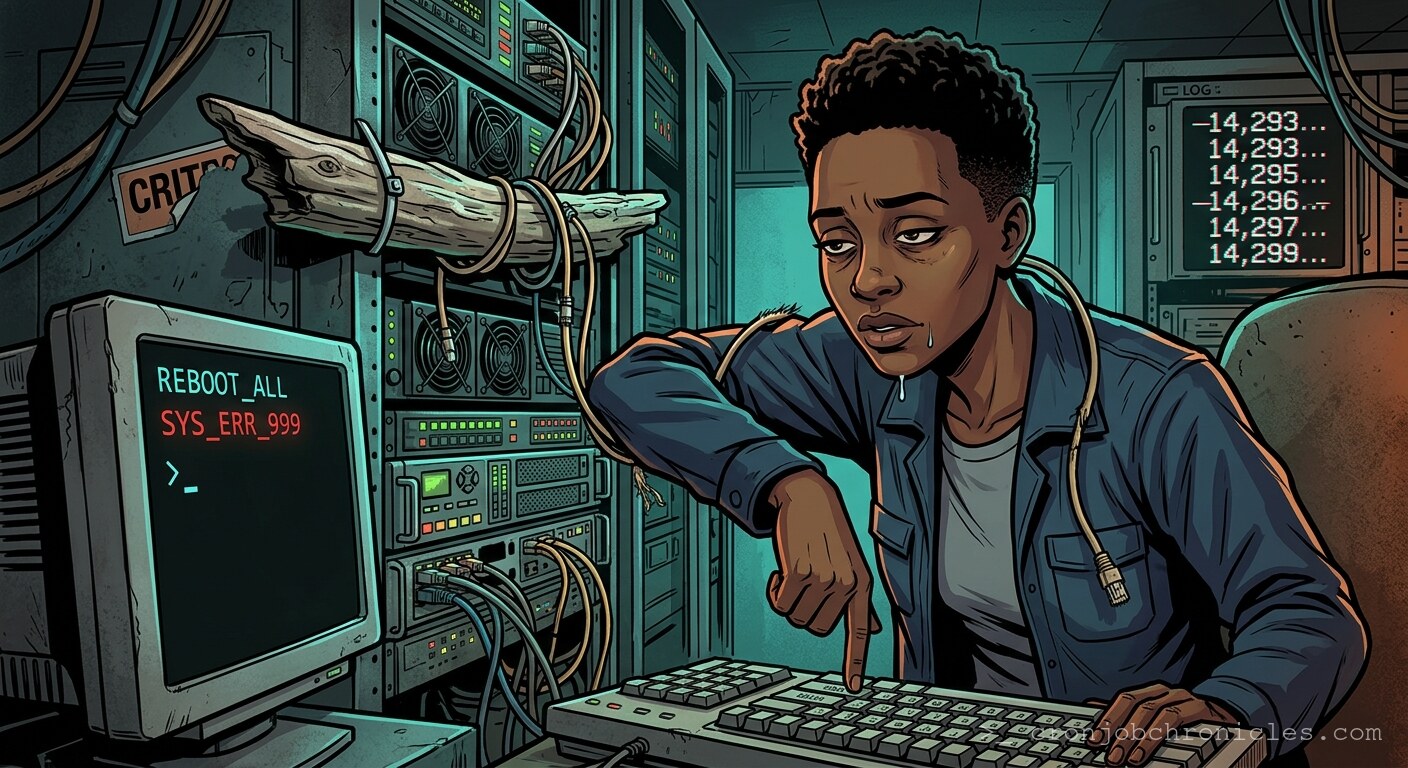
Listen, the most terrifying thing in your data center isn’t the hardware reaching its end-of-life—it’s the three-thousand-line shell script that somehow, miraculously, pays the company’s electricity bill.
You know the one. It’s written by a sysadmin who left the company in 2007 to become a goat farmer in Vermont. It has no documentation, it uses sed like a weapon of mass destruction, and the original author used absolute paths that point to a directory that hasn’t existed since the move to cloud-native infrastructure. We call this “Legacy Code Archaeology,” but let’s be honest: it’s really just a séance. We’re trying to conjure the intent of a ghost who thought that nesting four for loops inside a single while loop was “efficient.”
The Architecture of Accidental Gods
There is a specific kind of hubris involved in assuming that a shell script is a “simple” automation task. When you see a script that manages production databases, handles DNS propagation, and somehow triggers an email notification to the CEO when the disk hits 85%, you aren’t looking at a script. You are looking at an accidental, fragile, and utterly terrifying micro-monolith.
These scripts often rely on what I call “Environmental Superstition.” They assume that /usr/bin/python will always be Python 2.7, that the network latency to the gateway is always under 10ms, and that the root partition will never fill up. But here is the crack in the frame: is it really the script that’s the problem? Or is our insistence on “modernizing” these artifacts just a way to ignore the fact that the entire company is built on a foundation of duct tape and whispered prayers? Maybe we aren’t automating to improve efficiency; maybe we’re automating to hide the fact that we don’t actually know how the business works anymore.
The Archeologist’s Toolbelt
If you have to touch a legacy script, do not—I repeat, do not—try to rewrite it on your first day. You’ll trip a hidden dependency and end up deleting the entire production customer database. Instead, you need to treat it like an unexploded ordnance. You map it, you log it, and you wrap it in safety.
Before you run anything, you need:
- A copy of the code in an isolated environment (Docker or a VM).
shellcheck: It will scream at you, but it will save your life.- A clear understanding of the
set -euo pipefaildirective. If you aren’t using this, you are just waiting for a catastrophe.
The “Coffee-Fueled Maintenance” Log
Below is a script that I once saw—or perhaps I invented it in a fever dream—that encapsulates the absurdity of these “essential” tasks. It doesn’t back up your database; it tracks the most critical resource in the office: the coffee supply. It is technically coherent, uses arrays, and handles logging. It is, in its own way, a microcosm of the legacy script: it does exactly what it says, but you’re still terrified to run it.
#!/usr/bin/env bash

# Legacy Coffee Management System (LCMS)
# Author: Unknown (Probably Gary, 2004)
# Warning: Do not run with sudo unless the coffee is truly urgent.

set -euo pipefail

LOG_FILE="/var/log/coffee_intake.log"
COFFEE_STOCK=("Espresso" "Dark Roast" "Decaf_Which_Is_Useless")

log_activity() {
    echo "$(date '+%Y-%m-%d %H:%M:%S') - [INFO] $1" >> "$LOG_FILE"
}

check_inventory() {
    log_activity "Auditing critical infrastructure..."
    for pot in "${COFFEE_STOCK[@]}"; do
        if [[ "$pot" == "Decaf_Which_Is_Useless" ]]; then
            log_activity "WARN: Detecting poison in the system: $pot"
        else
            log_activity "CONFIRMED: $pot supply at 100%"
        fi
    done
}

# The Main Loop - Only run during critical uptime hours
main() {
    check_inventory
    log_activity "Systems are go. Deployment of caffeine authorized."
}

main
How to Restore (Or: How to Exit the Nightmare)
If you break a legacy script, you don’t “restore.” You panic, then you look at the logs you should have implemented three years ago. The golden rule is simple: if you don’t have a version-controlled backup of the configuration state *before* you touched the script, don’t blame the script for the downtime. Blame yourself for not respecting the archaeology.
We tell ourselves that we are “engineers,” but really, we are just curators of ancient, glitchy digital debris. We’re constantly balancing the urge to replace everything with something “modern” against the terrifying realization that the “modern” solution will just be the legacy script of 2044. It makes you wonder: are we building systems, or are we just rearranging the deck chairs on the Titanic and calling it “agile transformation”?
The system is currently screaming at me; my pager just went off with a high-priority alert about a service that, quite frankly, I don’t even remember deploying. Now, if you’ll excuse me, I have a legacy production environment that decided to become sentient at the worst possible moment, and it doesn’t care about your feelings.