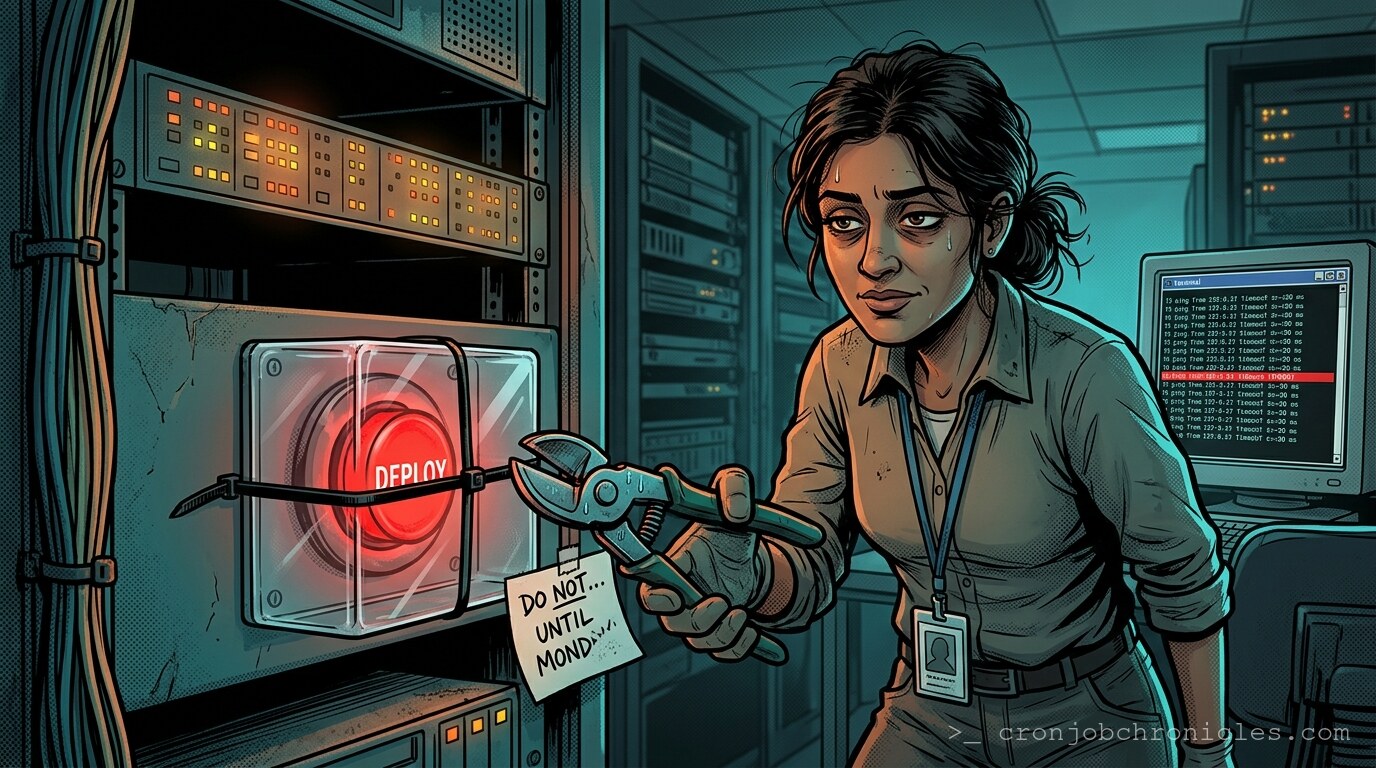
Listen, if you are currently staring at a “Deploy to Production” button on a Friday afternoon, you are not a systems administrator; you are a sadist who enjoys the sound of a pager screaming at 3:00 AM on a Saturday.
In our line of work, we tend to talk about “Read-Only Friday” as if it’s a sacred commandment etched into the silicon of our data centers. It’s the folklore of ops—the belief that if we keep our hands off the keyboard for 48 hours, the universe will stabilize, the entropy of our distributed systems will pause, and the ghosts in the machine will go to sleep. But maybe that’s just a comforting myth we tell ourselves to feel like we’re in control of systems that are, by their very nature, uncontrollable.
The Architecture of Impending Doom
A production environment is not a static object; it is a living, breathing, hemorrhaging ecosystem. When you push a commit at 4:30 PM on a Friday, you are essentially initiating a root-level modification on a patient who is already sedated but likely harboring a hidden pathology. You aren’t just “deploying code”; you are gambling that the dependency graph you validated in staging hasn’t shifted in production due to an obscure network jitter or a race condition that only appears under heavy load.
It’s a curious thing, the human drive to “finish things” before the weekend. We treat the deployment pipeline like a closing task at a coffee shop—wipe the counter, turn off the lights, lock the door. But code isn’t a counter. Code is a dynamic configuration of electrons that thrives on chaos. Why do we think the weekend offers a sanctuary? If anything, the weekend is when the silent killers—the memory leaks, the certificate expirations, the storage overflows—decide to wake up.
The “Read-Only” Fallacy
Is “Read-Only Friday” actually about system stability, or is it just a collective realization that our support teams are human? When a core service dies on a Wednesday at 10 AM, you have the full might of your engineering cohort—caffeinated, alert, and capable of a collective post-mortem. When that same service dies on a Friday night while your Lead SRE is three beers into a dive bar conversation about BGP routing, you have a panic-stricken on-call engineer trying to read a 400-line stack trace on a smartphone screen.
Perhaps the “Read-Only” culture isn’t a technical necessity, but a confession of our own fragility. We pretend it’s about the bits and bytes, but it’s really about the limitations of the meat-based processors maintaining the infrastructure. We are the weak link in the uptime equation. And yet, we continue to build systems that demand 99.999% availability while we, the architects, desperately require 100% sleep.
The Friday “Stabilization” Protocol
Since we’re all pretending that doing nothing is a “strategic choice,” let’s at least make the “doing nothing” feel productive. If you absolutely must have a script on a Friday, make it one that acknowledges the absurdity of our existence.
#!/bin/bash

# Friday_Cooldown.sh
# A script to ensure the sysadmin is not actually working.

LOG_FILE="/var/log/read_only_friday.log"
exec > >(tee -a "$LOG_FILE") 2>&1

echo "[$(date '+%Y-%m-%d %H:%M:%S')] Initializing Read-Only Friday safeguards..."

# Check if it is indeed Friday
DAY=$(date +%u)
if [ "$DAY" -lt 5 ]; then
    echo "It is not yet Friday. Back to work, peasant."
    exit 1
fi

# Define the 'Deployment' check
function deploy_attempt() {
    echo "Attempting to push to prod..."
    sleep 2
    echo "ERROR: Your manager is at the pub. Operation aborted."
    return 1
}

# The true function of a Friday sysadmin
function brew_coffee() {
    echo "Searching for caffeine sources..."
    sleep 1
    echo "Status: Coffee levels critical. Redirecting resources to the breakroom."
}

# Execution
deploy_attempt || brew_coffee

echo "[$(date '+%Y-%m-%d %H:%M:%S')] System is stable. Do not touch anything."
exit 0
Restoration: When the Theory Meets the Reality
Of course, there is always the inevitable failure. If you broke the “Read-Only” rule, you likely need a way back. Restoration is not just about `git revert` or `rsync` from a backup. It’s about psychological restoration. If you deployed on a Friday and things went south, stop trying to fix it at 11 PM. You will make it worse. The most sophisticated recovery tool in your arsenal is a cold shower and a walk outside. The system is already broken; you cannot break it any further by waiting until Monday morning when your logic, and your team’s collective IQ, is restored to nominal levels.
There is a lingering doubt in the back of my mind—is this “Read-Only” culture actually keeping us safe, or are we just delaying the inevitable collapse until Monday morning, effectively shifting the “Friday Disaster” into a “Monday Crisis”? Maybe we aren’t protecting the systems. Maybe we’re just protecting our Friday nights.
Now, if you’ll excuse me, I have a cron job that’s been failing since 3 AM and it doesn’t care about your feelings, or my desire to have a quiet drink.