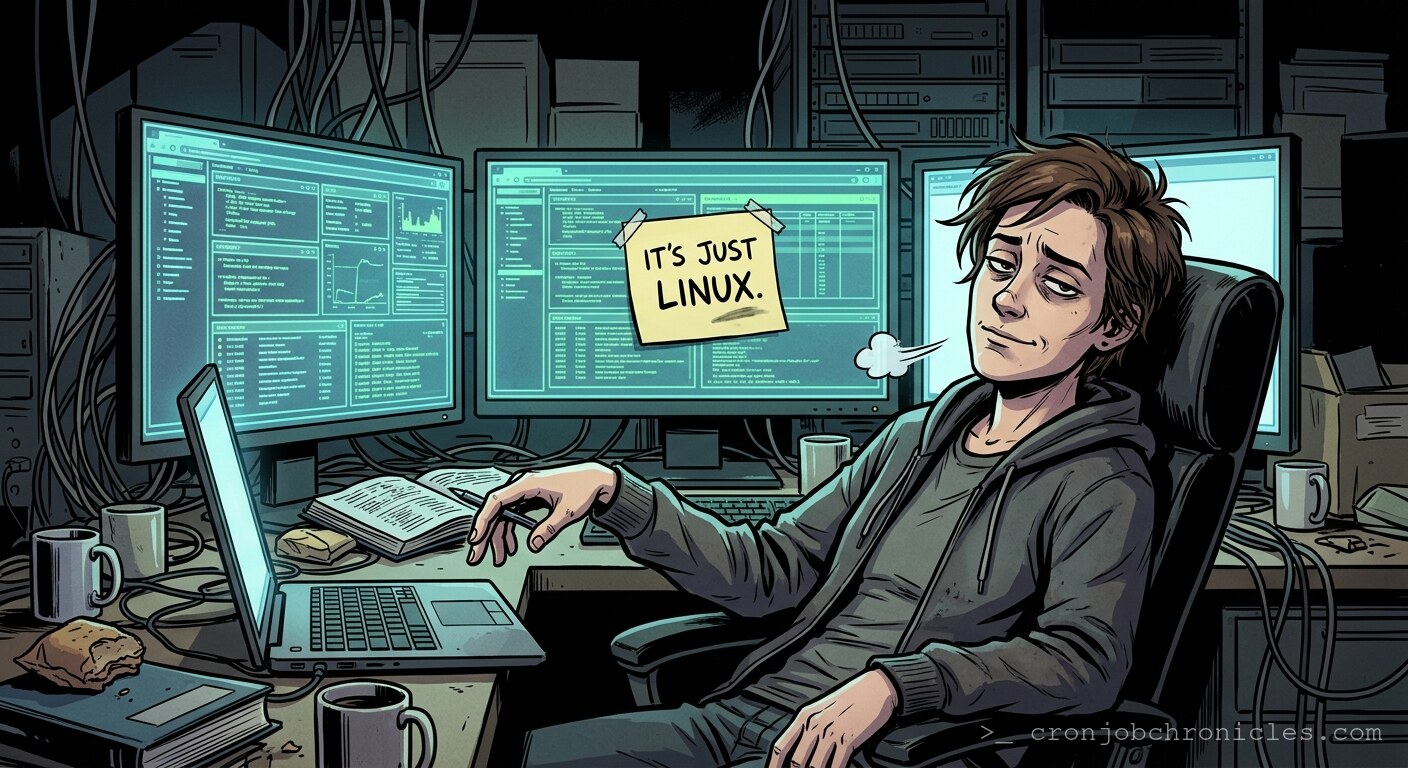
Listen, the title you put on your LinkedIn profile is just a shell script running with elevated privileges that you definitely didn’t vet before executing.
I’ve spent two decades watching the industry rename “the person who fixes the servers” into a parade of increasingly abstract nomenclature. First, we were System Administrators. Then, the industry decided that was too drab, so we became DevOps Engineers, then Site Reliability Engineers, and now, the current flavor of the month: Platform Engineers. It’s a fascinating form of linguistic virtualization, isn’t it? We keep adding layers of abstraction, hoping that if we rename the bucket, the bits inside will stop leaking.
Here is the hard truth that nobody in the marketing department wants to admit: under the Kubernetes manifests, the Terraform modules, and the bespoke Go-based internal developer platforms, you are still running a process on a physical or virtual machine. You are still dealing with disk latency, network partitions, and entropy. When the packet drops, it doesn’t care if you call yourself a “Cloud Native Architect.” It just drops.
The Illusion of the Platform
What we tend to call “Platform Engineering” is essentially an attempt to build a custom kernel for the enterprise. We build these complex abstractions to hide the “ugly” reality of Linux from our developers. But I wonder—are we making things easier, or are we just creating a more sophisticated way to get lost in our own architecture? Every abstraction layer we add is a potential point of failure that we no longer know how to debug without ten pages of documentation.
I’ve seen engineers spend three weeks building a CI/CD pipeline to automate a task that would take thirty seconds with a sed command and a prayer. We treat complexity like a status symbol. Perhaps the question isn’t how we can build a better platform, but why we’re so terrified of the machine itself. Maybe the fear of the terminal is what actually drives the industry, and these titles are just our collective defense mechanism against the kernel panics that haunt us.
A Practical Guide to Managing Your “Human Platform”
Since we’re all so obsessed with orchestration, let’s apply that same logic to our own sanity. Below is a technically sound, logically coherent Bash script designed to manage the most volatile system in the room: yourself. It handles the critical task of coffee intake and context-switching, which is, in my experience, the only real DevOps tool that matters.
#!/bin/bash
# human_platform_manager.sh
# Usage: ./human_platform_manager.sh --caffeine-level low

set -euo pipefail

LOG_FILE="/tmp/admin_sanity.log"
exec > >(tee -a "$LOG_FILE") 2>&1

log() { echo "[$(date +'%Y-%m-%dT%H:%M:%S')] $1"; }

caffeine_refill() {
    log "Initiating coffee injection sequence..."
    sleep 2
    echo "Refilling caffeine buffer... [|||||-----] 50%"
    sleep 1
    log "Caffeine levels optimized. Context-switching capability restored."
}

if [[ "$1" == "--caffeine-level" && "$2" == "low" ]]; then
    caffeine_refill
else
    log "System stable. No intervention required."
fi

# Edge Case: If the human is still tired, reboot.
# (Do not actually reboot the human.)
Restoration: How to Get Back to Basics
When the platform breaks—and it will, because distributed systems are a lie we tell ourselves to sleep at night—you need a restoration plan. For us, restoration isn’t about running an ansible-playbook; it’s about stripping away the abstractions. If the platform is failing, stop looking at the dashboard. SSH into the node. Look at the dmesg output. Check the thermal throttling on the host. The restoration of sanity always happens at the root level, far away from the shiny web UI.
We think we’re managing “Platforms,” but we’re really just managing entropy. Every deployment is a minor disaster in waiting, and our job is simply to delay the inevitable collision between reality and our configurations. It might be that the best “Platform Engineer” is just the one who knows when to stop adding layers and start reading the logs.
I have to cut this short. The monitoring tool just sent a push notification that the database cluster has decided to go into read-only mode for no discernible reason, and my pager is vibrating with the kind of intensity that suggests a long, cold night in the server rack. It doesn’t matter what my job title says; the kernel panic waits for no one.