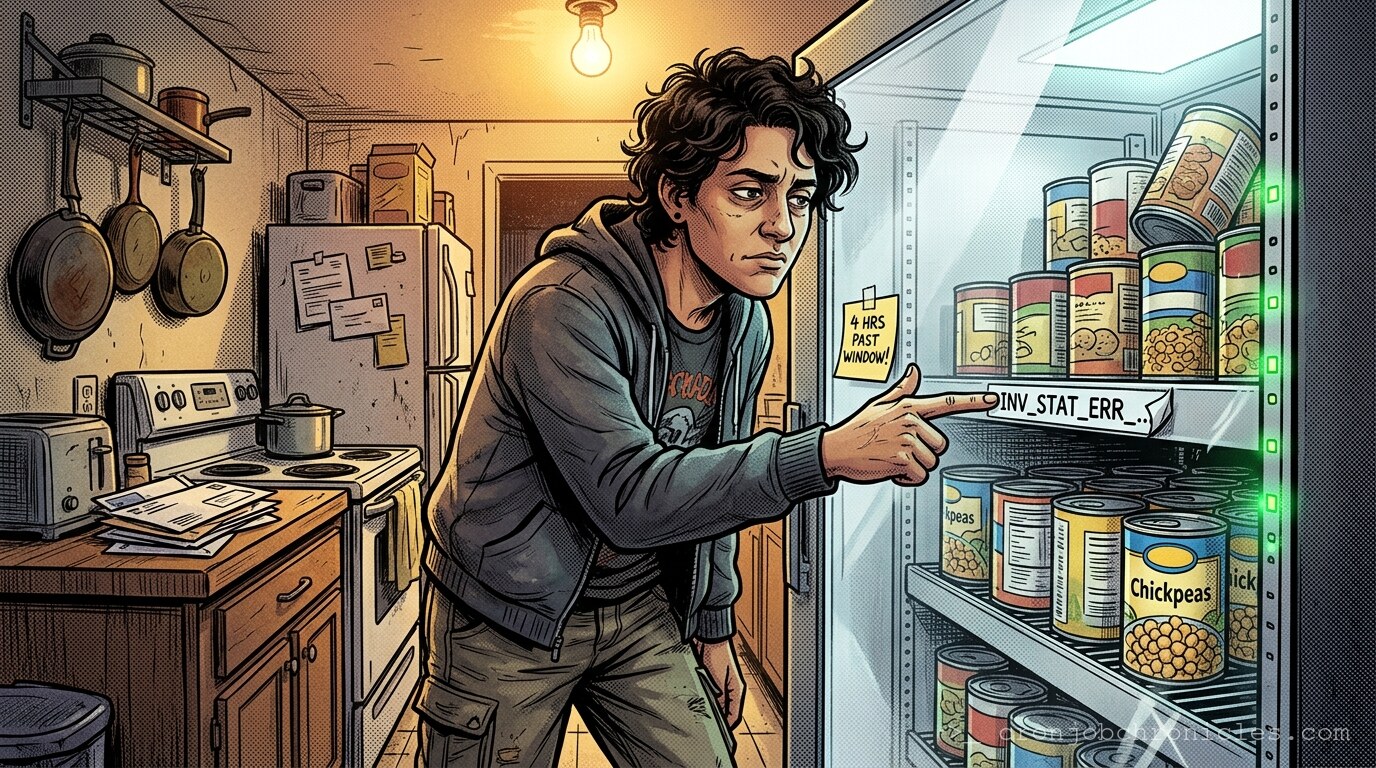
Listen, your grocery shopping strategy is essentially an unversioned, high-latency deployment pipeline currently prone to catastrophic state drift.
I see it every day: people walking into a supermarket without a repository-driven workflow. They treat their pantry as a volatile, non-persistent memory buffer. They lack audit trails, they lack atomic commits, and they wonder why they end up with three jars of cumin and zero milk when the integration tests—your breakfast—fail on a Monday morning. We treat our lives like production environments, yet we manage our household logistics with the stability of a developer testing in prod on a Friday night without a rollback plan.
I started version-controlling my groceries not because I’m obsessive, but because the alternative is a slow slide into entropy. When you treat your shopping list as a master branch and your kitchen as a live production server, you begin to see the beauty of the distributed VCS.
The Architecture of Sustenance
First, you need to acknowledge that your kitchen is a stateful system. The entropy of a pantry is high; items disappear through consumption and expire through temporal decay. If you aren’t running periodic diffs between your desired state (a full pantry) and your current state (the void left by your last coffee run), you are just guessing. Guessing is for juniors. Professionals work with known states.
To implement this, you must treat every trip to the store as a merge request. You don’t just “go shopping.” You fetch the latest upstream (the pantry scan), you perform a dependency check (do I have eggs?), and you create a feature branch (the specific list for this trip). Only when the items are successfully checked out and integrated into the kitchen do you merge back into the main branch.
Edge Cases: The Disaster Recovery of Dinner
We have to talk about the reality of human error—the “user input” problem. What happens when you reach for the almond milk and it’s curdled? That’s a 500 error in your morning routine. You need a contingency, a high-availability failover. In my house, the “failover” is a shelf of long-life staples that exist in a cold-standby state. I don’t touch them unless the primary system fails.
And let’s be honest: is this really about groceries? Perhaps we cling to version control because the world outside the terminal is terrifyingly mutable. Maybe our obsession with tracking inventory is just a way to impose a deterministic structure on a chaotic existence that refuses to adhere to our constraints. It’s a layer of abstraction we build between ourselves and the realization that everything—every process, every server, every container—is slowly, inevitably trending toward 0.
The Grocery List Repository Script
I’ve written a simple shell utility. It won’t buy your food, but it will prevent you from experiencing the “I forgot the cilantro” race condition. It treats your grocery list as an immutable log.
#!/bin/bash
# grocery_commit.sh - Maintaining state for the kitchen
# Usage: ./grocery_commit.sh "item_name"

LOG_FILE="/home/admin/kitchen_logs/pantry_state.log"
TIMESTAMP=$(date +"%Y-%m-%d %H:%M:%S")

if [ -z "$1" ]; then
    echo "[ERROR] $TIMESTAMP: Empty input detected. Commit aborted."
    exit 1
fi

echo "[$TIMESTAMP] ADDED: $1" >> "$LOG_FILE"

if [ $? -eq 0 ]; then
    echo "[SUCCESS] $TIMESTAMP: $1 synced to local repo."
else
    echo "[CRITICAL] $TIMESTAMP: Write failure. Check filesystem permissions."
    exit 2
fi
Restoration Procedures
If you lose your list—say, you dropped your phone in the produce section—you don’t panic. You look at your logs. The log is your single source of truth. If you’ve maintained your pantry_state.log, the restoration is trivial: cat pantry_state.log | tail -n 10. There is your state. There is what you needed. You don’t have to rely on your fallible, carbon-based RAM. You rely on the disk.
Is this an over-engineered solution to the mundane act of buying bread? Perhaps. But I look at the people wandering the aisles, aimlessly scrolling through their minds, trying to remember if they have salt, and I feel a profound sense of pity. They are running without a manifest. They are deploying into the void.
Of course, I realize that even with perfect version control, the underlying hardware—my body—is still prone to silent data corruption and hardware failure. I can track the groceries with the precision of a kernel developer, but I cannot version-control the passage of time or the creeping sense that perhaps, just perhaps, the system isn’t meant to be stable at all.
Hold on—I’m getting a flood of alerts from the monitoring dashboard. The primary database cluster in the Tokyo region just spiked to 98% CPU utilization and the standby node is refusing to acknowledge the heartbeat. My inventory logs can wait; the servers are screaming, and they don’t give a damn about my grocery list.