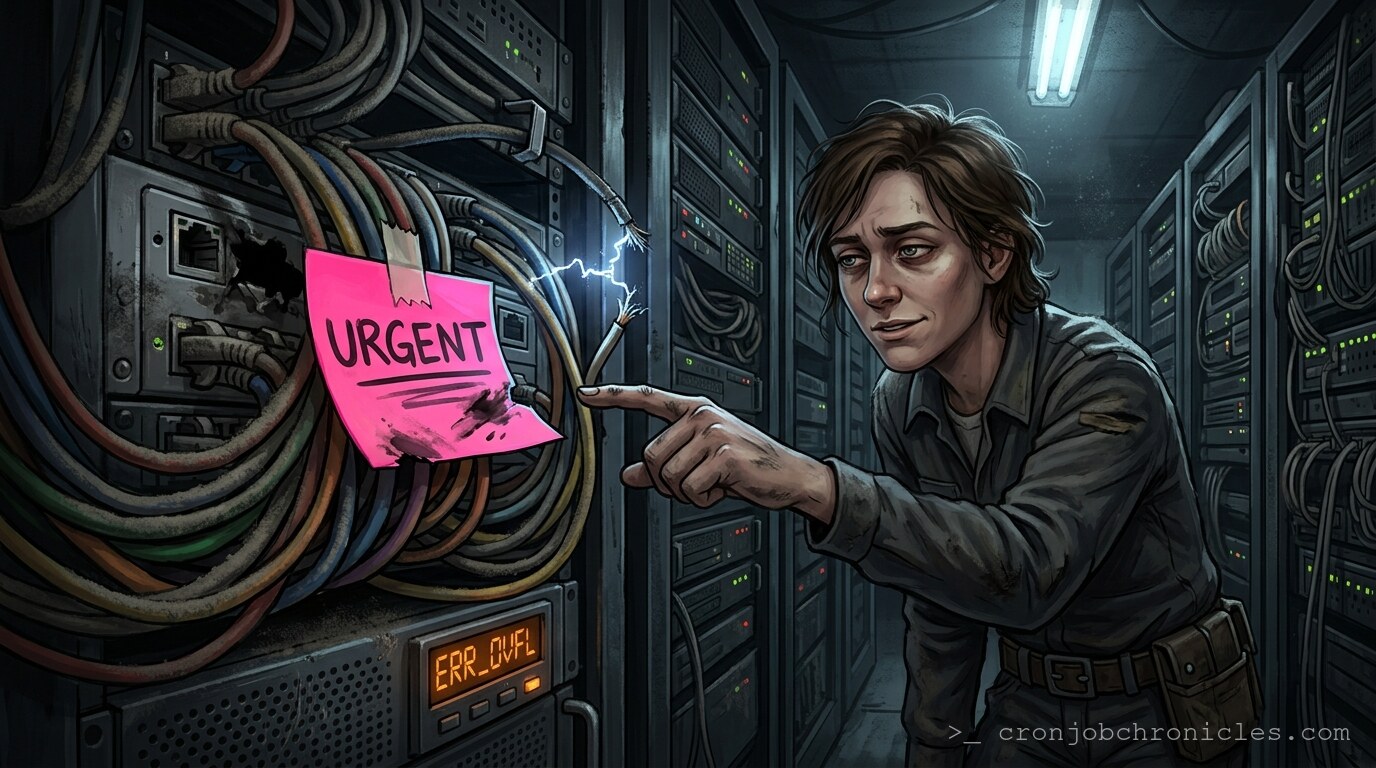
Listen, the word “Urgent” is the digital equivalent of a frantic sticky note on a sinking Titanic.
I’ve spent two decades in the trenches of the data center, and if there is one thing I’ve learned, it’s that “Urgent” is not a priority; it is a confession of systemic failure. When a ticket hits my queue tagged with that singular, desperate label, I don’t see a crisis. I see the manifestation of 15 years of technical debt compounding like a high-interest payday loan from a lender that doesn’t accept bankruptcy filings.
We treat IT infrastructure as if it were a garden we tend, but it is actually a sprawling, sentient junkyard. We bury legacy dependencies under layers of abstraction, pretend that `sudo` is a cure-all, and then act surprised when the application layer starts throwing 503s because a hard-coded absolute path broke after a kernel update. And yet, when the incident happens, we run to the ticket queue, label it “Urgent,” and hope the gods of uptime look the other way.
The Archaeology of a “Hotfix”
In my line of work, we often find ourselves digging through ticket histories. We call it “Ticket Archaeology.” You start at the top—the current fire—and you dig down through the strata of previous “urgencies.” You find a layer of bash scripts from 2012, followed by a layer of manual configuration tweaks made by a sysadmin who hasn’t worked here since the Obama administration, all capped off by a desperate comment from last week saying, “Just force-restart the service, we’ll fix the memory leak later.”
We are all just layering chaos on top of chaos, and calling it “agile.” Is it really an “Urgent” incident if the service was designed to fail under load three years ago? Or are we just performing the same ritualistic dance of blame-shifting to satisfy stakeholders who don’t know the difference between a load balancer and a light switch?
The Ritual of the “Urgent” Ritual
Sometimes I wonder if we actually want these systems to be stable. Stability is boring. Stability is automated provisioning, idempotent configurations, and well-documented infrastructure-as-code. That doesn’t get you a “Hero of the Month” award during a midnight outage. Only “Urgent” incidents provide the adrenaline hit that makes a sysadmin feel alive. We perpetuate the debt because we are addicted to the archaeology of the fix.
Maybe the question isn’t “How do we handle the urgency?” but “Why do we feel so naked without the crisis?” Perhaps our technical debt is actually the only thing keeping us tethered to the machine. Without it, we are just glorified babysitters of servers that never actually need us.
Automating the Existential Dread
Since we insist on treating our lives as a series of urgent, irreconcilable conflicts, I wrote a script to manage the only thing in my life that actually has a predictable lifecycle: my morning cup of coffee. It’s a simulation of the “Urgent” request process—complex, largely unnecessary, and guaranteed to fail if you don’t keep an eye on the hardware.
#!/bin/bash
# Priority_Coffee.sh: Simulating a high-stakes deployment to the breakroom.

LOGFILE="/var/log/coffee_crisis.log"

exec > >(tee -a "$LOGFILE") 2>&1

echo "[$(date)] CRITICAL: User caffeine levels reaching critical threshold."
echo "[$(date)] Initiating manual override for beverage procurement."

# Simulate dependency check (The "Is there milk?" crisis)
for i in {1..3}; do
    echo "[$(date)] Checking inventory... Attempt $i"
    sleep 1
done

# The inevitable "Urgent" failure
if [[ $RANDOM -lt 16384 ]]; then
    echo "[$(date)] ERROR: Dependency conflict found. No milk. Deploying black coffee fallback."
    exit 1
else
    echo "[$(date)] SUCCESS: Beverage deployment successful. User morale +5."
fi

# Cleanup
echo "[$(date)] Documentation of incident complete. Marking ticket as 'Closed: Resolved by caffeine'."
exit 0
The Restoration of Sanity
If you find yourself buried in “Urgent” tickets, stop digging. The archaeology only reveals that you are digging a deeper hole. Restoration isn’t about clearing the ticket; it’s about refactoring the debt. You restore sanity by deleting the “Urgent” button and replacing it with a “Why is this happening?” whiteboard.
But then again, maybe that’s just the talk of someone who hasn’t slept properly since 2008. Perhaps we’re all just cargo-culting competence while the bits rot in the background. It’s hard to tell from the inside, isn’t it? The more we “fix,” the more the systems seem to drift away from the original intent, until the only thing left of the original design is the name of the host in the `/etc/hostname` file.
Wait—my monitor just started screaming in red text. It seems the load balancer in the primary region has decided that “up” is merely a suggestion rather than a state of being. I have to go; the pager is vibrating against my desk like a trapped hornet and it really doesn’t care about my philosophical musings on the nature of technical debt.