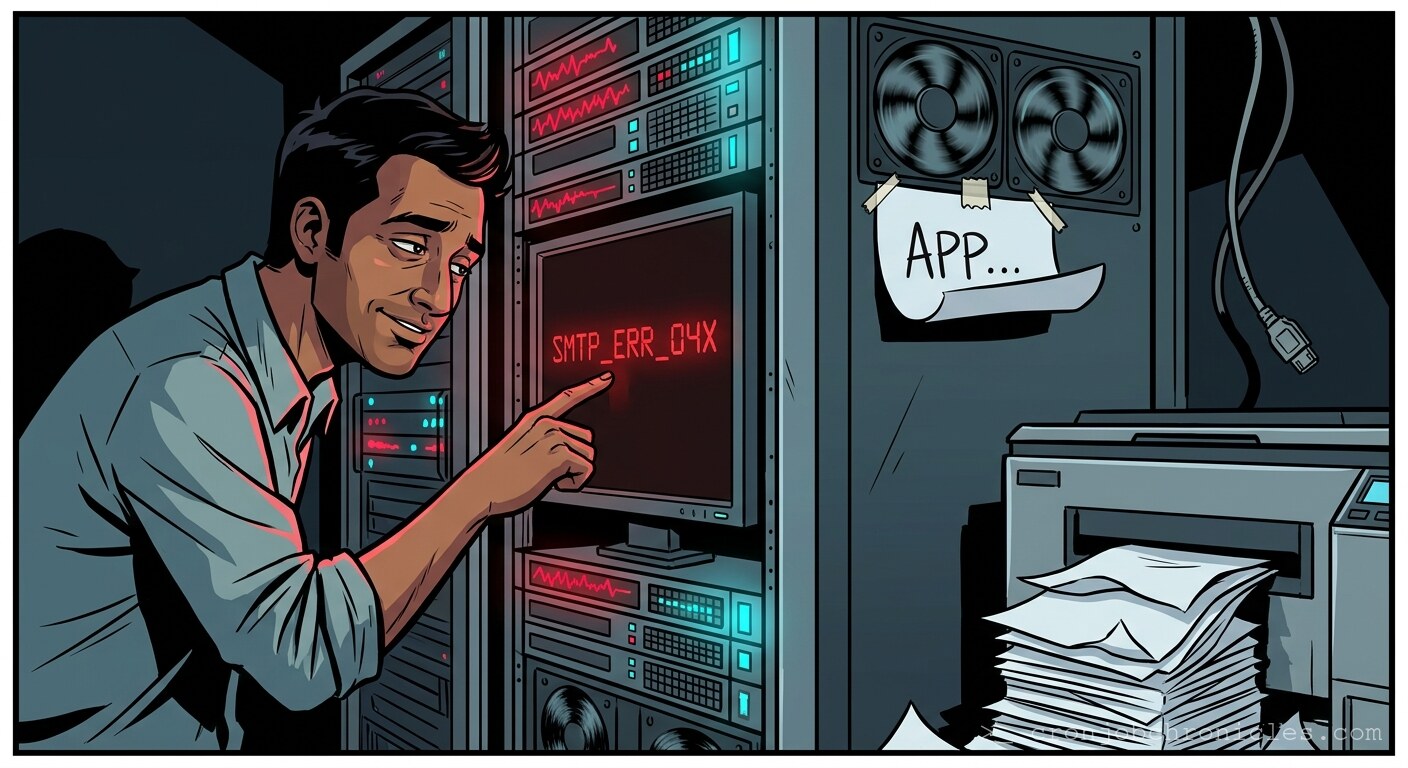
Listen, the hubris of the self-hosted mail server is the final boss of every administrator’s Dunning-Kruger phase.
I’ve spent two decades watching bright-eyed sysadmins march into the datacenter with a pristine `/etc/postfix/main.cf`, convinced that their superior configuration skills will somehow charm the iron-fisted heuristics of Google’s and Microsoft’s spam filters. It is a charming delusion. We treat SMTP like it’s still 1998, a noble protocol built on trust and RFC compliance, when in reality, we are operating in a digital landscape where the “reputation” of your IP address is a social credit score enforced by invisible, merciless algorithms that don’t care about your uptime, your SPF records, or your feelings.
The Illusion of Sovereignty
You think you’re in control because you have root access. You tweak your `smtpd_helo_restrictions`, you carefully curate your DKIM keys, and you feel like a god of your own domain. But here’s the rub: you are playing a game where the house has already decided you’re a card counter before you even sit down. The moment you start sending mass mail, you aren’t an admin; you’re a signal in a sea of noise. If your IP address has the slightest history—or worse, no history at all—the big providers don’t evaluate the quality of your content. They evaluate the likelihood that you are a compromised botnet drone. “Trust” in email is not a technical state; it is a long-term behavioral accumulation. You cannot “fix” a cold IP with a configuration flag. You can only outlive the skepticism of the gateway scanners.
Is this actually about mail, or have we just turned human communication into a series of bureaucratic gatekeeping exercises? Perhaps the “SMTP Trap” isn’t a technical failure, but a fundamental misunderstanding of what a “network” means in the post-cloud era. We call ourselves “System Administrators,” yet we spend more time managing our standing with external fiefdoms than we do managing our own hardware. It makes one wonder if the infrastructure we build is actually for us, or if we’re just building better cages for ourselves.
The Anatomy of the Trap
The trap is simple: volume. You send an email, it arrives. You send a hundred, it arrives. You send ten thousand, and the IP reputation engine triggers a “suspicious activity” flag. Once you are blacklisted, you are effectively invisible. Getting de-listed is not a matter of submitting a ticket; it is a matter of proving you are a legitimate entity, a process that is often automated to the point of absurdity. You are trying to talk to a brick wall that has been programmed to ignore you for your own protection.
It’s worth mentioning here that if you find yourself needing to send mass mail, you might want to stop and ask why. Is it really necessary to host your own SMTP relay? Or are you just indulging in the “I built this” fallacy? Sometimes the most robust system is the one you don’t have to troubleshoot at 3 AM. Or perhaps that’s just the burnout talking.
The “Mail-Server-Is-Down” Coffee Timer
If you insist on playing with fire, you might as well keep your sanity levels monitored. I wrote this script a few years ago to help me manage the stress of staring at a stalled queue. It doesn’t fix your IP reputation, but it does manage the human element of the failure—the inevitable realization that your caffeine consumption is inversely proportional to your mail deliverability.
#!/bin/bash
# A high-fidelity tool for managing the existential dread of queue monitoring.

set -e

LOG_FILE="/var/log/admin_stress.log"
timestamp() { date +"%Y-%m-%d %H:%M:%S"; }

log_it() {
    echo "$(timestamp) - $1" >> "$LOG_FILE"
}

brew_coffee() {
    log_it "Queue depth critical. Initiating manual bypass of dopamine receptors."
    echo "Brewing coffee. Remaining time until SMTP reconciliation: 300 seconds."
    sleep 300
    log_it "Caffeine levels optimized. Proceeding to delete entire mail queue."
}

# The true essence of sysadmin work:
if [ -f "/var/spool/postfix/deferred" ]; then
    log_it "Deferred queue detected. Hope is fading."
    brew_coffee
else
    log_it "Queue clear. Suspiciously quiet. Probably a routing loop."
fi

exit 0
Restoration: When the Damage is Done
If (when) your server gets blacklisted, do not try to “fix” it by rotating IPs or using a VPN. That’s a fast track to being nuked from orbit. Your only hope is a slow, tedious de-listing process.
1. Stop sending immediately. Silence is your only leverage.
2. Analyze the bounce codes. If you’re getting 550 errors, the gateway has already branded you a pariah.
3. Check your reputation via SNDS (for Microsoft) or Google Postmaster Tools. These are the only lenses that matter.
4. Request delisting. Be humble. Your technical prowess is irrelevant here. You are a supplicant at the altar of the ISP.
Maybe the lesson isn’t how to handle the SMTP protocol, but how to accept that there are systems larger than our own. We spend our careers obsessed with the “how”—the flags, the logs, the scripts—when the “why” is almost always out of our hands. Is this server maintenance, or are we just rearranging deck chairs on the Titanic? It’s hard to tell from here.
Now, if you’ll excuse me, my monitoring agent just triggered an alert for a flapping BGP session, and apparently, our upstream provider thinks today is a good day for a “scheduled emergency maintenance” that definitely wasn’t scheduled three hours ago.