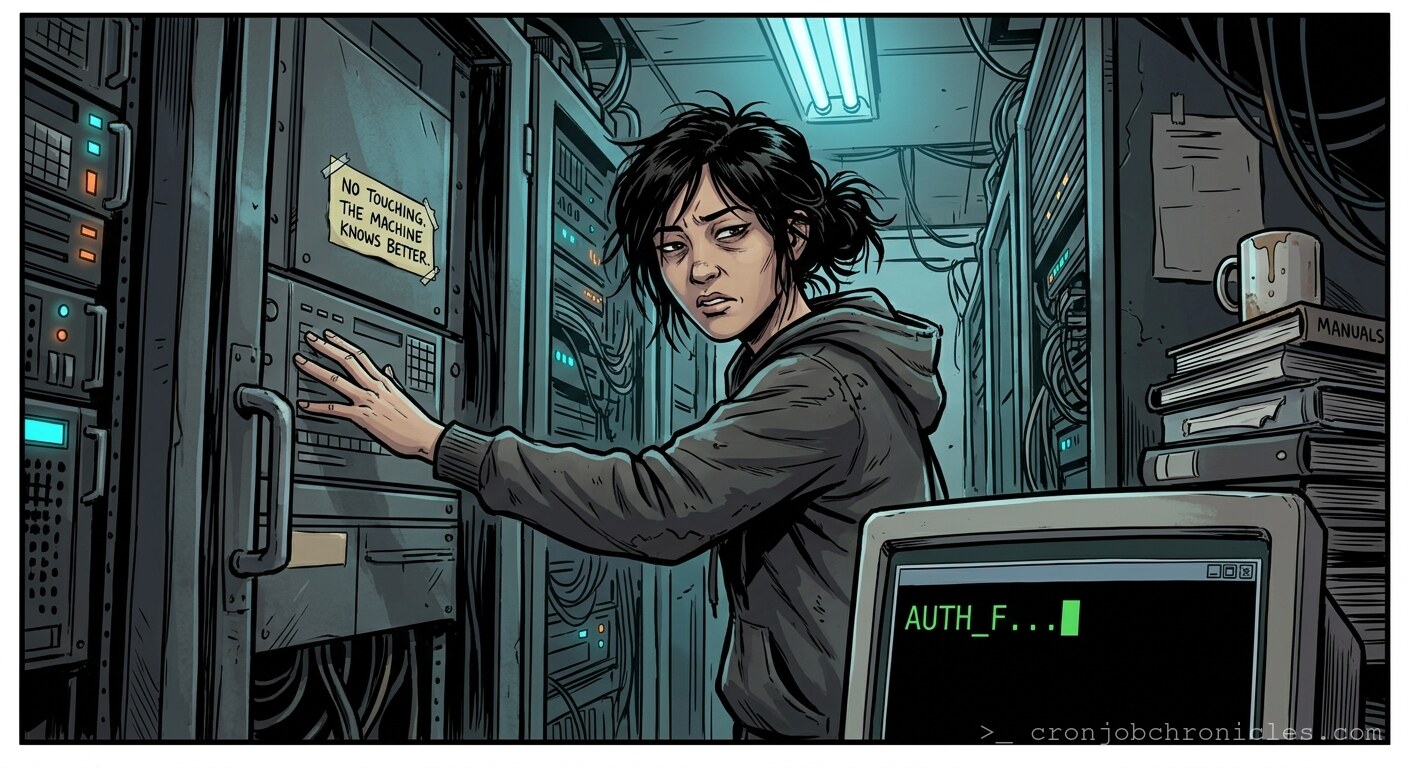
Listen, if your server isn’t essentially acting like a paranoid, caffeine-addled sysadmin with a vendetta against entropy, you aren’t running infrastructure—you’re running a ticking time bomb.
Most admins treat security as a seasonal event, like spring cleaning or remembering to call their mother. They run a vulnerability scan, see a mountain of CVEs, sigh, fix two of them, and go back to drinking lukewarm office coffee. This is how you end up on the front page of a cybersecurity tabloid. True infrastructure integrity isn’t about state; it’s about reconciliation. You want a system that notices when its environment drifts and snaps back into formation like a drill sergeant.
The Concept: Drift is the Enemy
Configuration drift is the silent killer. A developer tweaks an `iptables` rule to “test something” at 3:00 AM, forgets to revert it, and three weeks later, your production database is visible to the entire internet because of an open port. We aren’t building “static” servers; we are building systems that enforce their own desired state. If it deviates, it self-corrects. If it can’t self-correct, it alerts and screams until someone pays attention.
Prerequisites: The Essential Toolkit
- Aide (Advanced Intrusion Detection Environment): Because checking file hashes manually is for masochists.
- Systemd Timers: Stop using crontab for critical tasks. Systemd timers provide better logging, dependency management, and tracking.
- A Logging Pipeline: If your server heals in the woods and no one logs it, did the healing ever happen? Use journald to forward logs to a centralized stack (ELK or Graylog).
- Immutable Logic: Keep your configuration scripts in a version-controlled repo. If you’re manually editing files in `/etc/`, you’ve already lost the war.
The Proactive Integrity Loop
You need three pillars: Auditing, Reconciliation, and Reporting.
First, AIDE establishes a baseline of your binaries and configs. It snapshots the system state. If a rootkit drops a malicious shared object into `/usr/lib64/`, your integrity check should trip immediately. Don’t just watch the file system; watch the service state.
Here is a piece of code that serves as your “sanity anchor.” It checks if your crucial services are running and your firewall state is intact. If it finds drift, it resets the world.
#!/bin/bash
# The "Sysadmin's Patience" Auditor
# Because if the firewall is down, your weekend is already ruined.

LOG_FILE="/var/log/integrity_check.log"
REQUIRED_SERVICES=("nginx" "sshd" "fail2ban")

log() {
    echo "$(date '+%Y-%m-%d %H:%M:%S') - $1" | tee -a "$LOG_FILE"
}

log "Running proactive integrity check..."

# Check Firewall (The "Don't be an idiot" test)
if ! iptables -C INPUT -p tcp --dport 22 -j ACCEPT >/dev/null 2>&1; then
    log "CRITICAL: SSH access rule missing! Rebuilding firewall rules..."
    /usr/local/bin/deploy_firewall.sh # Assume this script defines your ground truth
fi

# Service Health (The "Are you still alive?" test)
for svc in "${REQUIRED_SERVICES[@]}"; do
    if ! systemctl is-active --quiet "$svc"; then
        log "WARNING: $svc is down. Attempting resurrection..."
        systemctl restart "$svc"
        if [ $? -eq 0 ]; then
            log "SUCCESS: $svc recovered."
        else
            log "FAILURE: $svc is a brick. Escalating to PagerDuty."
            # Call your notification API here
        fi
    fi
done

log "Integrity check complete. System is sane (for now)."
The Restoration Protocol
If you don’t have a restore process, you don’t have a backup. You have a “hope-based data storage system.”
- Snapshot: Before any “healing” happens, take a LVM snapshot or a filesystem snapshot (ZFS/Btrfs).
- Verify Hash: If AIDE reports a corruption in a binary, do not try to patch it. Revert the file from your immutable source (e.g., re-install the package from your local repository).
- Configuration Audit: If an integrity check fails, diff the current config file against the Git repository. If they don’t match, overwrite the current config with the Git version and reload the daemon. If you don’t know why it changed, you don’t trust the file.
Edge Cases: Why Your “Self-Healing” Might Kill You
Automated remediation is dangerous. If you have a process that automatically restarts a service, ensure you have a “circuit breaker.” If the service fails to start three times in five minutes, your script should stop trying and alert you. You don’t want a “self-healing” loop to turn into a “self-denial-of-service” attack where you’re constantly cycling PID files and crashing the memory buffer.
Also, keep an eye on your storage. If your “healing” logs are writing to disk at 100MB/s, you’ll run out of inodes before the next audit. Keep the logs rotated, or your “smart” server will kill itself out of sheer exhaustion.
My pager is currently vibrating with a “high latency” alert from a node that I suspect is suffering from an runaway garbage collector, and frankly, I’ve got about thirty seconds to get to the terminal before the boss starts asking questions I don’t want to answer. Keep your binaries clean and your logs cleaner.