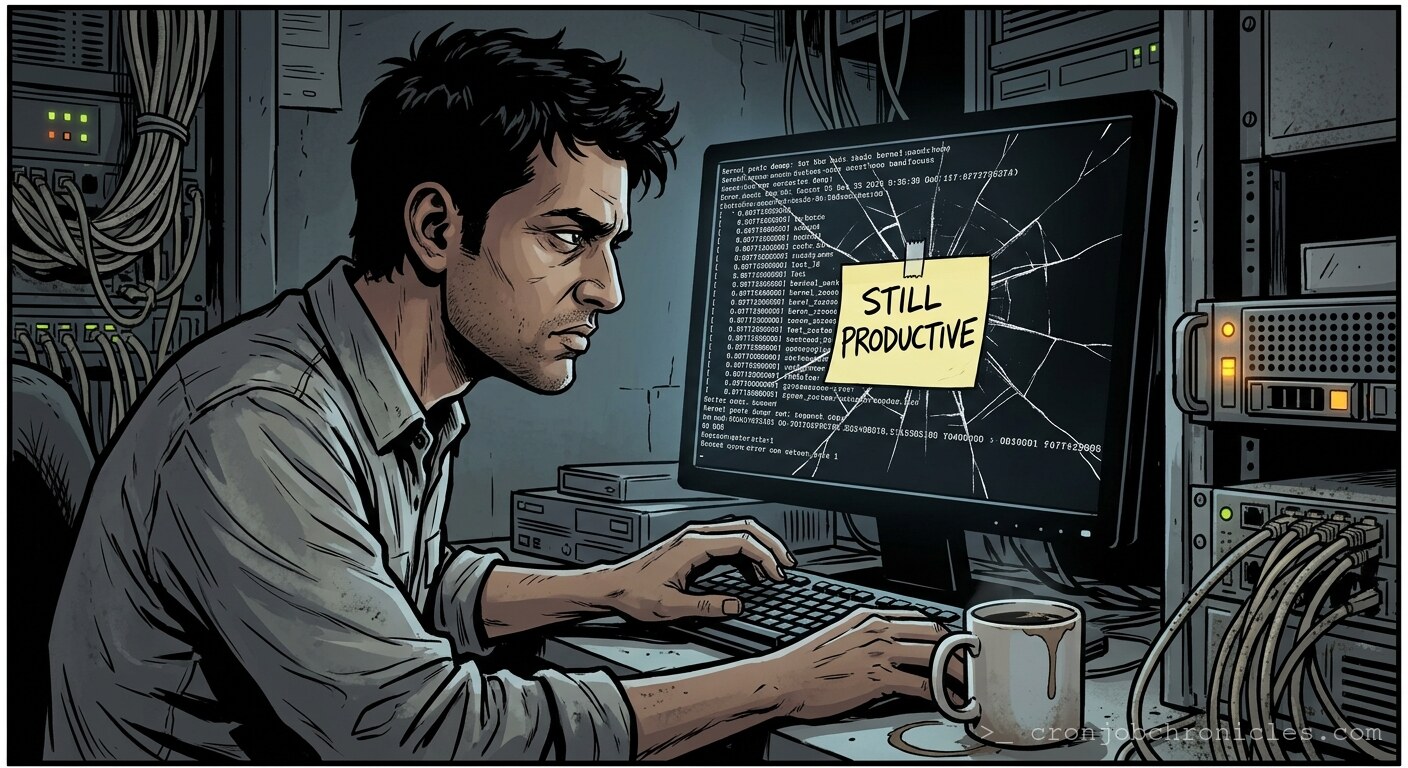
Listen, most sysadmins treat a kernel panic like a sudden heart attack, but in reality, it’s more like a polite resignation letter from an overworked civil servant who’s finally had enough.
You’ve been there. You’re staring at a terminal that has suddenly gone static, a frozen wall of text that looks like a bad art project. The kernel—the grand arbiter of your CPU cycles, the master of your memory address space—has hit a situation it wasn’t programmed to navigate. It didn’t just crash; it panicked. It looked into the abyss of a null pointer dereference or a catastrophic hardware interrupt, and it decided that the only honest thing to do was to stop the world entirely.
People often ask me, “How do I prevent the panic?” This is perhaps the wrong question. A kernel panic is a symptom, not a disease. It’s the system’s way of preventing data corruption by opting for self-immolation. If you could prevent every panic, you would likely just end up with a system that silently hemorrhages data until your database is essentially a collection of random noise. We crave stability, but we might actually be craving the illusion of it.
The Anatomy of the Last Gasp
When the kernel panics, it enters a state of high-alert triage. It writes its final thoughts to the console buffer—the “last words” if you will. You’ll see things like EIP/RIP (Instruction Pointer), which tells you exactly where the processor was standing when the cliff appeared, and the Stack Trace, which is the system’s way of saying, “Here is a list of all the bad decisions that led me to this moment.”
We obsess over logs, but logs are stored in memory or on disk. If the kernel panics hard enough, those buffers never flush. The disk might be unreachable. The filesystem might be locked. This is the moment the machine stops being a computer and becomes a brick. It’s a profound reminder that all our virtualization and orchestration are just thin, brittle shells draped over physical reality.
The Essential Toolkit
Before you start digging through core dumps, ensure you have the environment to actually read them. You aren’t going to parse a binary core dump with cat. You need:
- kdump/kexec: The mechanism that loads a secondary kernel into memory to capture the dying one.
- crash utility: The only way to interact with a kernel dump that doesn’t involve losing your sanity.
- debuginfo packages: Without these, you’re just looking at hex gibberish.
When the Panic Isn’t the Enemy
Sometimes, we force the panic. Using the Magic SysRq key (echo c > /proc/sysrq-trigger) is a move I reserve for the most desperate of deadlocks. It’s a kill switch that bypasses the scheduler and forces a panic. It’s a brutal, honest way to get a dump of a system that is currently doing nothing but eating power. It’s the technical equivalent of a stern conversation with a coworker who has been staring blankly at their monitor for three hours. Sometimes, you just need to see what they were thinking before they checked out.
A Practical, If Slightly Existential, Script
I wrote this little helper utility. It doesn’t fix a panic—nothing does—but it logs your sanity levels while you wait for the system to finish dumping core to the disk. If you’re going to be up at 4 AM, you might as well track your caffeine intake.
#!/bin/bash
# Caffeine-to-Panic ratio tracker.
# Usage: ./sanity_tracker.sh [cups_consumed]

set -euo pipefail

LOG_FILE="/var/log/admin_sanity.log"
TIMESTAMP=$(date +"%Y-%m-%d %H:%M:%S")

if [[ $# -eq 0 ]]; then
    echo "Need coffee count."
    exit 1
fi

CUPS=$1

echo "[$TIMESTAMP] Status: Kernel Panic. Coffee consumed: $CUPS. Hope left: Minimal." >> "$LOG_FILE"

if [ "$CUPS" -lt 3 ]; then
    echo "Warning: Critical lack of caffeine. Panic probability increasing."
else
    echo "Caution: Hand tremors may affect keyboard input. Proceed with caution."
fi
Restoration: The Reality Check
If you’re reading this, your system likely didn’t recover. Restoration isn’t about “fixing” the panic; it’s about reverting to a state where the panic didn’t exist. You restore your LVM snapshots, you rollback your configuration management (Puppet, Ansible, whatever flavor of chaos you subscribe to), and you cross your fingers that the hardware fault isn’t persistent. If the panic was caused by a faulty RAM module, your backup won’t save you. You’ll just watch the same crash happen again in two hours. That is the true, quiet horror of the data center.
Perhaps we should stop trying to build “un-crashable” systems and start building systems that assume failure is the base state. We treat the kernel panic like an error, when it might just be the system’s way of keeping us humble. We think we are managing the machine, but we are really just observers waiting for the inevitable moment when the machine decides it has seen enough of our configuration files.
Now, if you’ll excuse me, I have a rack in the back that’s currently screaming an IPMI alert and I need to go see if the redundant power supply actually decided to be redundant or if it was just lying to me the whole time.