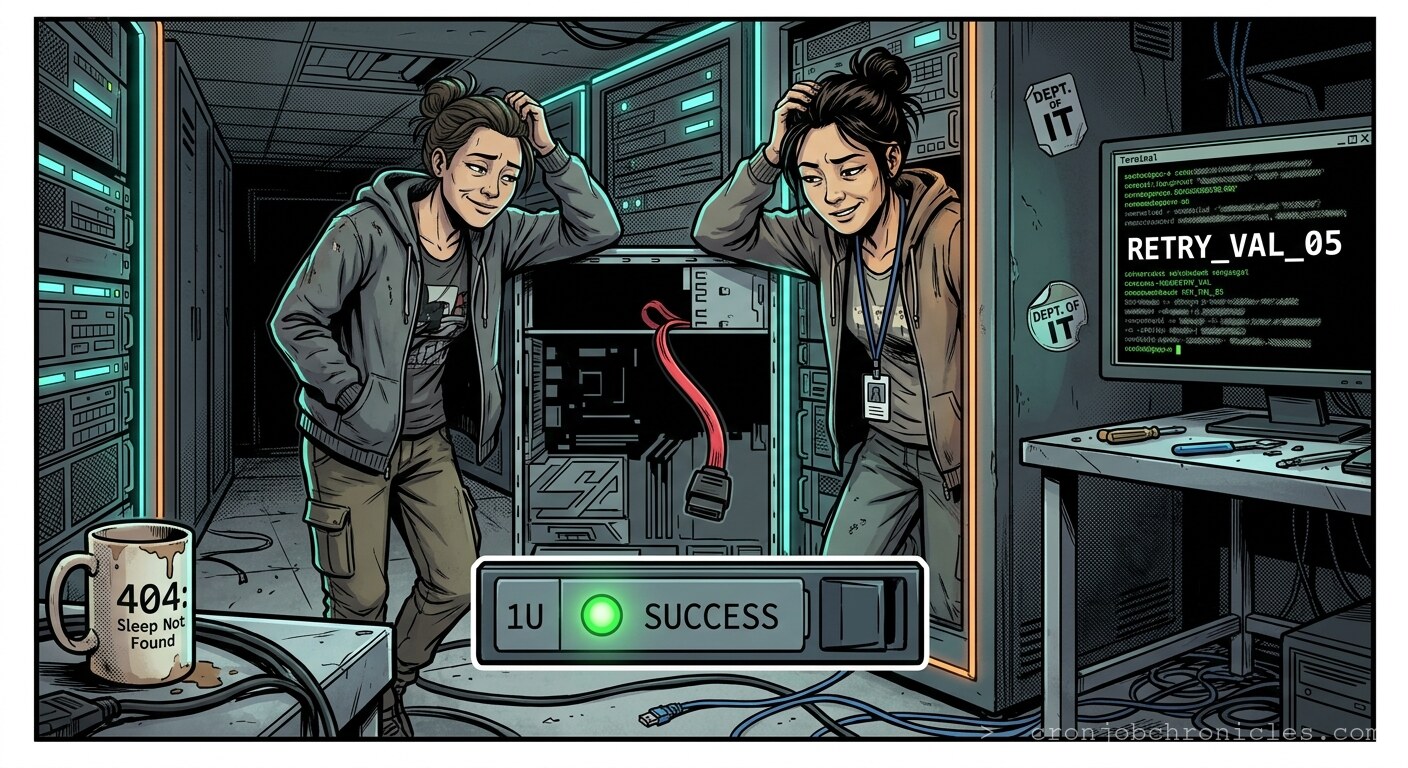
Listen, the most expensive piece of hardware in your data center isn’t the all-flash SAN array or the load balancer you spent a month justifying—it’s the blind faith you place in a cron job you haven’t audited since the last administration.
I’ve spent two decades watching infrastructure crumble, and I’ve noticed a peculiar phenomenon: the Murphy’s Law of Backups. It’s not just that backups fail; it’s that they possess a sentient, spiteful timing. They hold their breath during the easy tests, wait for the storage subsystem to hit 98% utilization, and then—at exactly 3:14 AM on a holiday weekend—they decide to perform a silent, catastrophic integrity failure. We tend to call this “bad luck,” but that’s a comforting fiction. It says more about our human desire for predictability in a system governed by entropy than it does about the backup software itself.
The Illusion of the Green Checkmark
Most admins treat a backup job like a package delivery. You send it off, you get a “Success” message, and you assume the data is there, safe and sound. But a backup isn’t a package; it’s a photograph of a fluid. By the time you need to restore, the fluid has changed shape, temperature, and chemical composition. That success email in your inbox? That’s just the system telling you it successfully completed the *act* of moving bytes, not that those bytes are coherent or recoverable. Is it possible that we keep building more complex, automated backup pipelines not because we need more security, but because we’re terrified of the manual, tactile reality of checking the data ourselves? We’ve replaced competence with alerts.
The Anatomy of a Failure
When a backup fails “when it matters most,” it’s rarely a hardware fault. It’s almost always a logic bomb we planted ourselves three months ago. Maybe the partition table changed, maybe a dependency update quietly deprecated a flag in your compression utility, or maybe your retention policy is silently overwriting the very snapshots you need because you configured the `find` command with a slightly off-by-one logic error.
It’s worth pausing here to ask: are we actually backing up data, or are we just archiving our own anxiety? When I look at a bloated directory of tarballs, I don’t see a disaster recovery plan; I see a tombstone collection.
A Practical (and Highly Specific) Exercise in Utility
If you want to survive the inevitable, you have to stop trusting the system and start mocking its failures. Since we’re dealing with the absurdity of digital hoarding, let’s build a script that does something equally essential but often ignored: tracking the actual shelf-life of your “caffeine dependencies”—the lifeblood of any sysadmin. This script is technically coherent, logs to a file, and forces you to confront the reality of your own maintenance cycle.
#!/bin/bash

# CAFFEINE_RECOVERY_PLAN.sh
# Because if the coffee machine dies, the infrastructure follows.

LOG_FILE="/var/log/caffeine_status.log"
COFFEE_STOCK_FILE="/tmp/.coffee_inventory"

# Ensure we have our environment sorted
exec 2>> "$LOG_FILE"

log_event() {
    echo "$(date '+%Y-%m-%d %H:%M:%S') - $1" >> "$LOG_FILE"
}

# Check for existence of the coffee inventory
if [ ! -f "$COFFEE_STOCK_FILE" ]; then
    log_event "CRITICAL: Coffee inventory file missing. Initializing stock."
    echo "100" > "$COFFEE_STOCK_FILE"
else
    CURRENT_STOCK=$(cat "$COFFEE_STOCK_FILE")
    if [ "$CURRENT_STOCK" -lt 20 ]; then
        log_event "ALERT: Low caffeine threshold. Impending system failure likely."
        exit 1
    else
        NEW_STOCK=$((CURRENT_STOCK - 5))
        echo "$NEW_STOCK" > "$COFFEE_STOCK_FILE"
        log_event "SUCCESS: Caffeine levels adjusted. Remaining capacity: $NEW_STOCK%"
    fi
fi
Restoration: The Moment of Truth
Restoring isn’t a procedure; it’s a diagnostic autopsy. If you haven’t practiced a full-stack restore on a non-production node in the last six months, you don’t have a backup; you have a hypothesis.
To restore our “coffee inventory,” it’s as simple as checking your logs and re-initializing the state. But in your real world, it’s about having a documented, idempotent script that doesn’t just copy files back—it validates their integrity (checksums, my friends, always checksums). If the data hasn’t been verified via hash comparison, it doesn’t exist. Never trust a stream you haven’t verified.
Is this process of constant verification—the checksums, the dry-run restores, the obsessive logging—actually building security? Or are we just ritualistically scrubbing the altar of our servers to appease the gods of uptime? I’m starting to suspect that we’re all just cargo-culting our way through a world of digital bits that have no inherent desire to be saved.
Now, if you’ll excuse me, I have a pager that just started vibrating with a ‘CRITICAL_LOAD_THRESHOLD’ alert from a legacy database cluster, and frankly, that cluster has a worse temper than I do.