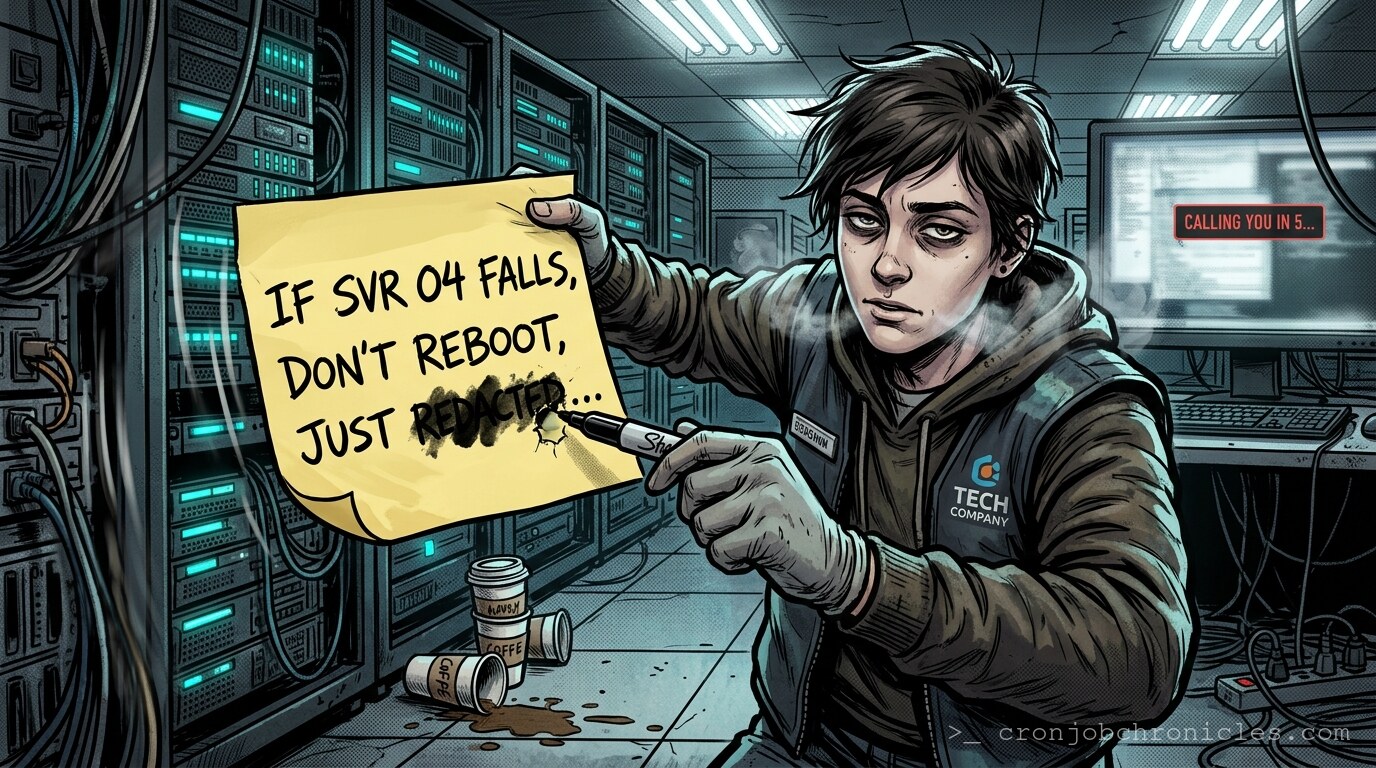
Listen, documentation is the equivalent of leaving a map for yourself in a dark, unfamiliar data center while the cooling system is failing and your pager is melting in your pocket.
Most engineers treat documentation like a chore—a tax levied on their creativity by management. They think they are writing for their boss, or for some nameless, faceless auditor from compliance. This is a profound misunderstanding of the job. You aren’t writing for them. You are writing for the version of you that will wake up at 3:14 AM on a Tuesday, with four hours of sleep, a head full of static, and a mission-critical service returning 503s because of a configuration drift you caused six months ago during a fever dream.
Documentation is a love letter to your future self. It is the act of mercy you perform for the panicked, frantic version of you that is trying to figure out why the load balancer is routing traffic into a black hole.
The Entropy of Memory
In our line of work, we tend to worship the idea of “self-documenting code.” It’s a beautiful sentiment, isn’t it? It suggests that if we just write clean, elegant enough functions, we won’t need to explain ourselves. It is a seductive lie. The human brain is a leaky bucket with a high rate of bit-rot. You can write the most elegant Bash script on the planet, but six months later, when the senior architect asks why you hard-coded an arbitrary delay after a service restart, you won’t remember the race condition you were trying to patch. You’ll just see the `sleep 10` and wonder if your former self was a moron. You weren’t a moron—you were reacting to a reality that no longer exists.
And here is the question that haunts me: are we actually documenting the system, or are we just creating a historical record of our own confusion? Sometimes, I wonder if the documentation is merely a coping mechanism for the fact that we are building systems far more complex than our ability to intuitively understand them. We write the manual so we don’t have to admit we’re just guessing.
The Infrastructure of Empathy
To document effectively, stop writing for the computer. You already have code for that. Write for the human you’ll be when you’re tired. If you’re debugging a weird routing issue, don’t just dump the `iptables` rules. Document the *intent*. Use a log of your own sanity. I like to keep a local maintenance log—not in a fancy Jira ticket that will be lost in the next migration, but in the repo itself.
#!/bin/bash
# coffee_logic.sh - Because even the admin needs a state machine.

LOG_FILE="/var/log/my_sanity.log"

log_event() {
    echo "$(date '+%Y-%m-%d %H:%M:%S') : [MAINTENANCE_LOG] : $1" >> "$LOG_FILE"
}

# The actual work
log_event "Applying hotfix for Nginx memory leak. Reverting to upstream-default."
systemctl restart nginx && log_event "Service back up. Note: If this fails again, check the logrotate configs, they are cursed."

# Exit handling is for people who trust their own code.
# We don't trust our code. We verify.
if [ $? -eq 0 ]; then
    log_event "System restored. Future me: Don't panic, the memory spike is a bug in the plugin, not the kernel."
else
    log_event "CRITICAL: The patch failed. May God have mercy on your soul."
    exit 1
fi
The Art of the Restore
The litmus test for any documentation is the ‘Restore’ section. If your documentation doesn’t explicitly state how to set the system on fire and then rebuild it from the ashes, it’s not documentation; it’s a list of suggestions. A true guide must be destructive. You need to know that your backup isn’t just a tarball sitting in a bucket; it’s a living, breathing reality.
How to Restore (or: How to avoid being the person who calls the vendor):
- Verify the checksums: You didn’t think the network would corrupt your backup, did you?
- Isolate the environment: Never perform a restore on a live production instance. Do I need to explain why? I hope not.
- Run the smoke tests: If the database is up but the application can’t hit the socket, you haven’t restored; you’ve just moved the failure to a different layer.
There is a terrifying possibility that we’ve collectively decided documentation is the answer because it’s the only part of the system we can actually control. We can’t control the hardware failures, the kernel panics, or the sudden, inexplicable behavior of the cloud provider’s API. But we can write a wiki page. We can write a README. It feels like stability. But is it? Or is it just a digital security blanket for admins who know deep down that the data center is a chaotic, irrational place?
Every time I document a workaround for a persistent bug, I am essentially saying, “I accept that this system is flawed.” It’s an act of radical honesty. You are acknowledging the technical debt and creating a roadmap for your future survival. It isn’t just best practice. It’s an act of kindness in a world that is inherently hostile to uptime.
Wait. My phone is vibrating. The alerting system is screaming that the primary failover cluster just hit a split-brain condition, and quite frankly, the documentation I wrote for this three years ago is looking very, very thin right about now. I have to go deal with a literal fire, not a metaphorical one.