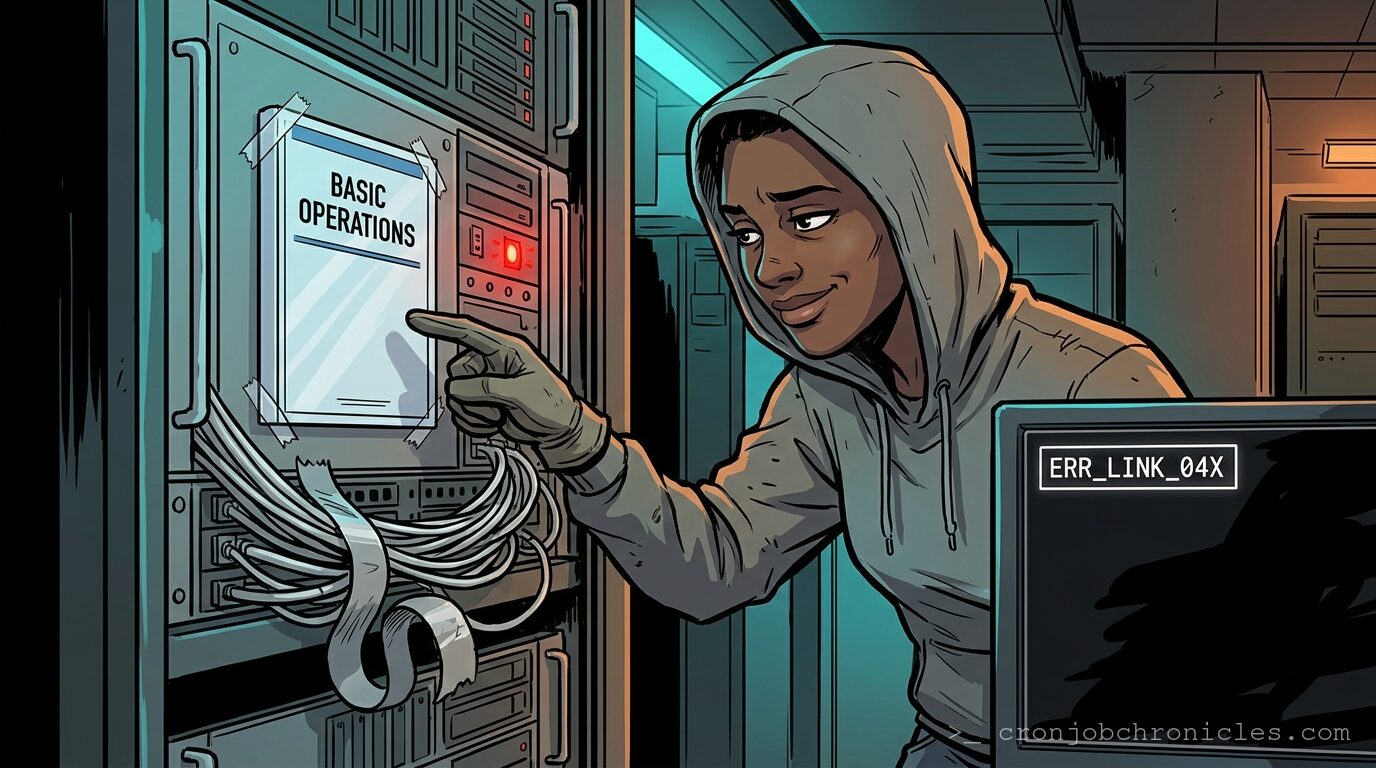
Listen, documentation is the most beautiful lie we tell ourselves in the data center.
We treat README files as sacred scripture, the burning bush of our repository. We assume that if a dev—or worse, a fellow sysadmin—took the time to document a deployment process, the laws of physics will hold steady until the installation completes. I’ve spent twenty years digging through the wreckage of “tried-and-true” guides, and I’ve learned that a README is often just a snapshot of a moment where everything happened to work once, by pure, unadulterated cosmic alignment.
When you see a line like apt-get install -y nginx in a README, you aren’t reading an instruction; you are reading a prayer. You are assuming the mirror site in the documentation is still active, that your network stack isn’t being throttled by a misconfigured edge firewall, and that the dependencies haven’t been deprecated into the void since 2019. It’s an exercise in blind faith that we perform before every catastrophic failure.
The Anatomy of a Technical Deception
Why do we lie? It’s not malice. It’s the optimism bias of the person who just solved the problem. They were in the “flow,” they patched the kernel, symlinked the library, and grepped the logs until the service finally stayed up for more than ten minutes. In that state of triumph, they open `README.md`, type out the commands that finally worked, and commit. They don’t mention the environment variables they set in their shell profile six months ago and forgot about. They don’t mention the specific version of glibc they were running. They forget the human cost of the technical debt they just papered over.
I find myself questioning if we are even asking the right questions when we write documentation. We focus on the “how,” but we rarely document the “why” or the “what if the world burns?” Perhaps documentation shouldn’t be a list of commands, but a list of the ways the author failed before succeeding. That would be an honest README. But no one wants to read that. We want the easy path, even if it leads us off a cliff.
The “It Worked for Me” Protocol
I once saw a guide for a distributed database that claimed, “Just run the binary; it auto-configures.” It did, indeed, auto-configure—right into a split-brain scenario that wiped half our test cluster because the author didn’t account for network latency in a cross-AZ deployment. The README didn’t lie about the command working; it lied about the reality in which the command would exist.
If you are writing a manual today, consider this: Is this document a tool for a colleague, or is it a vanity project to prove you figured it out? If it’s the former, you owe them the edge cases. You owe them the stderr output. You owe them the truth about what happens when the disk fills up while the database is flushing its WAL files.
The “Optimistic Admin” Utility
Since we are all prone to the same delusions, I’ve written a small tool. It doesn’t deploy your production stack—thank God—but it does handle the most honest part of our day: the cycle of hopeful execution and inevitable realization. It uses standard bash logic to simulate the “README lifecycle.”
#!/bin/bash
# The README-Optimism-Checker.sh
# Because sometimes the code works, and sometimes you just need to wait for the heat death of the universe.

LOG_FILE="/var/log/sysadmin_despair.log"

log_event() {
    echo "$(date '+%Y-%m-%d %H:%M:%S') - [INFO] $1" | tee -a "$LOG_FILE"
}

log_event "Consulting the sacred README.md..."
sleep 2

# The core simulation of reality
ACTIONS=("Installing dependencies" "Checking checksums" "Waiting for network" "Praying to the machine spirits")
for action in "${ACTIONS[@]}"; do
    log_event "$action..."
    sleep 1
done

# The edge case: Documentation vs. Reality
if [ $((RANDOM % 2)) -eq 0 ]; then
    log_event "SUCCESS: The README was accurate. Please report this anomaly to the dev team immediately."
else
    log_event "CRITICAL ERROR: Reality has deviated from documentation. Check your firewall, your soul, and your coffee levels."
    exit 1
fi
Restoration and Reality
When the README leads you into a swamp, don’t try to “fix” the documentation. Restore your state. If you aren’t taking atomic snapshots of your VMs or keeping your IaC (Infrastructure as Code) state in a verifiable version-controlled state, you are just gambling with someone else’s money. Always keep a rollback path, because the documentation is rarely the final truth; it’s just a suggestion that you are currently ignoring at your own peril.
It’s strange, really. We spend our lives building these complex, logical structures, yet we rely on such fragile, human-authored text to maintain them. Perhaps the documentation isn’t supposed to be correct; perhaps it’s supposed to be a test of our own intuition. If you follow a README blindly, maybe you deserve the outage that follows. Or maybe that’s just the cynicism of a sysadmin who’s seen too many `rm -rf` commands hidden in nested shell scripts.
I’m looking at the screen, and the alert volume is spiking—it seems like one of the nodes I just “optimized” using a 2017 Wiki entry has decided to stop heartbeat-ing entirely. Now, if you’ll excuse me, I have a cron job that’s been failing since 3 AM and it doesn’t care about your feelings.